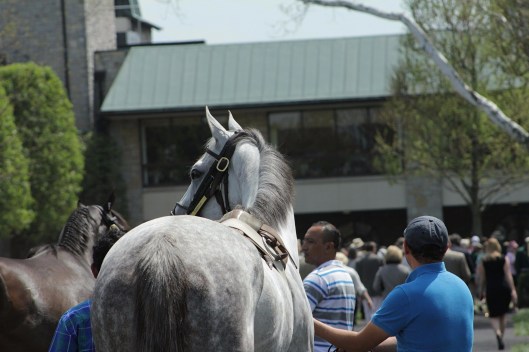
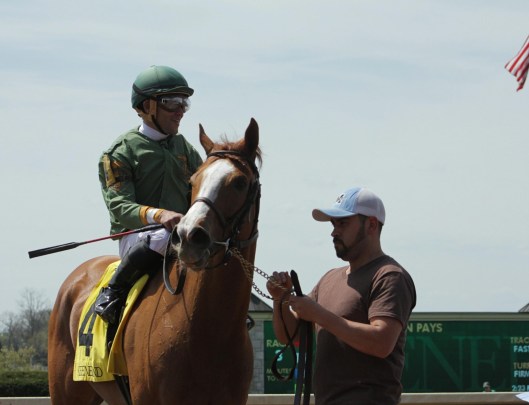
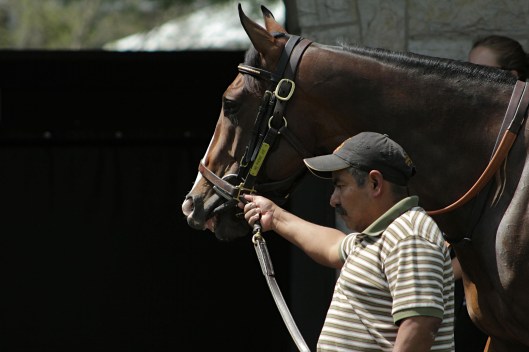
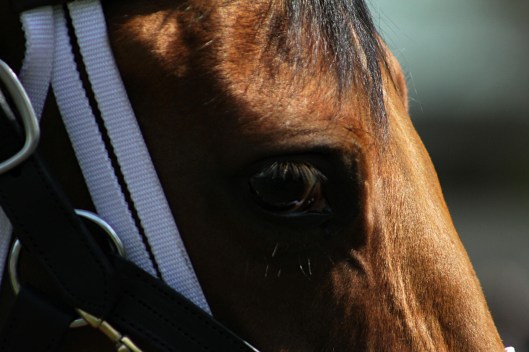
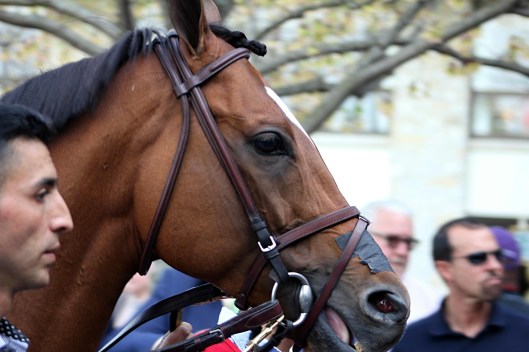
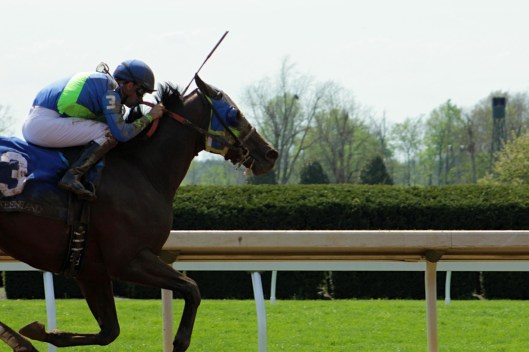
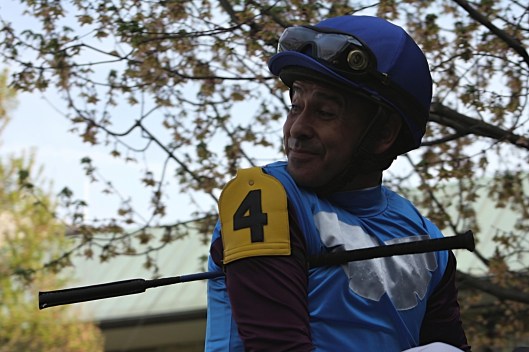
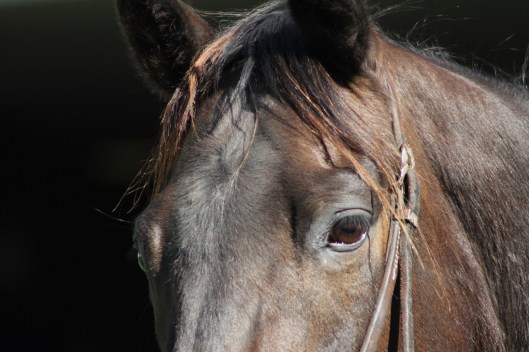
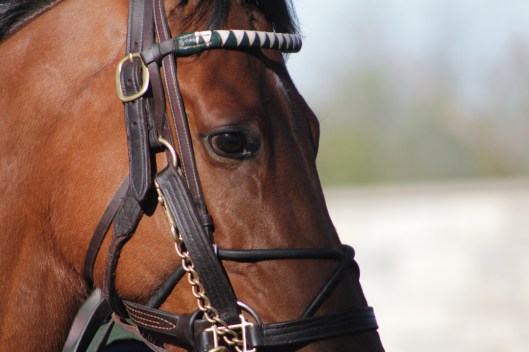
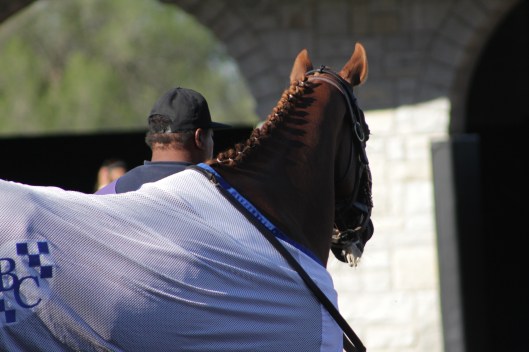
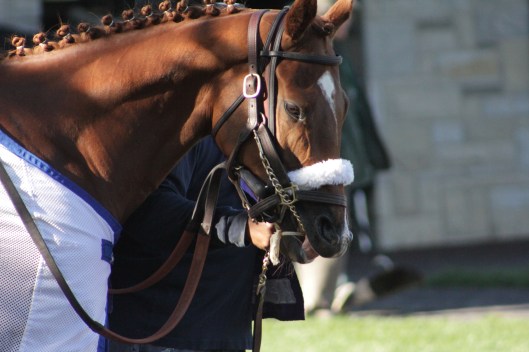
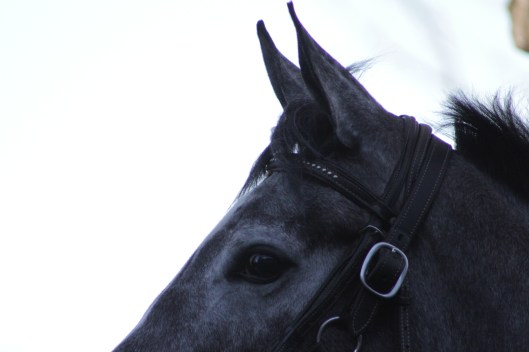
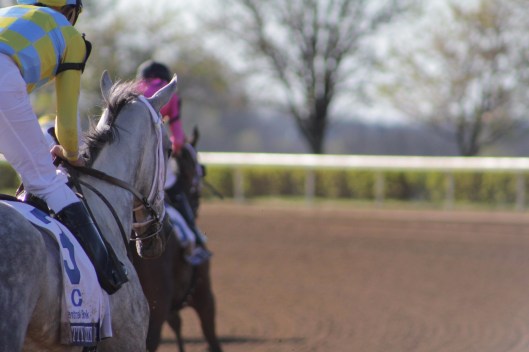
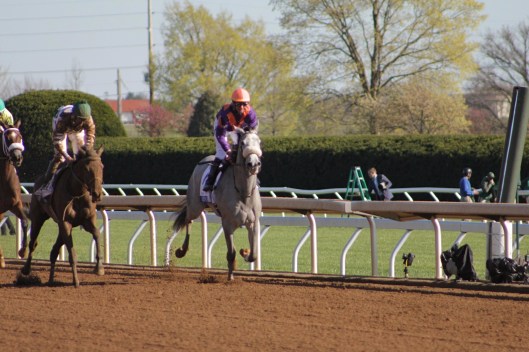
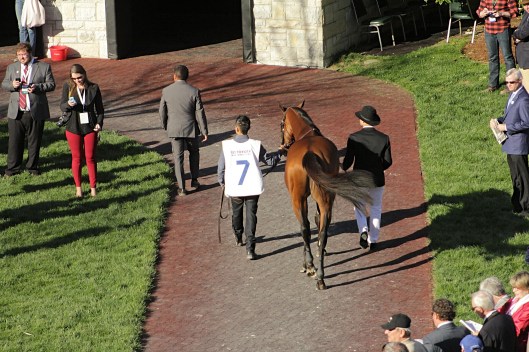
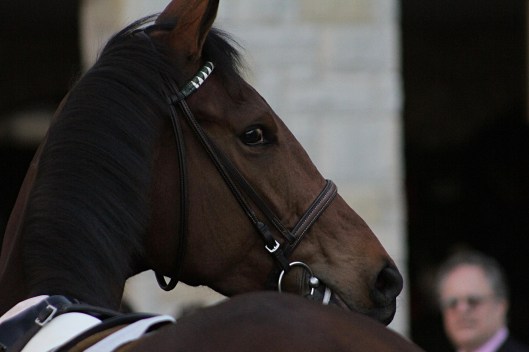
This post is in homage to what draws me to take photographs of these horses time and again, the glimpses of heart that I see in them, whether in the paddock, in repose, or in full flight down the track. It is what speaks to me most about them, that will to win and that drive to excel that so many of them possess.
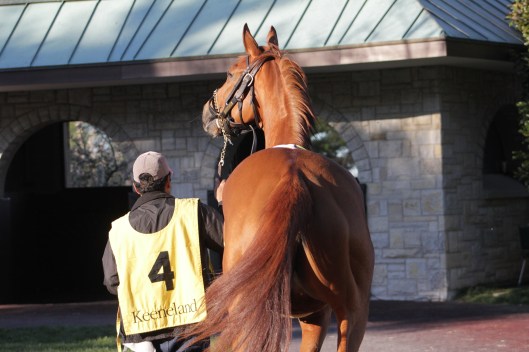
These images are all from the Keeneland spring 2017 meet, one of the most perfect places to be.
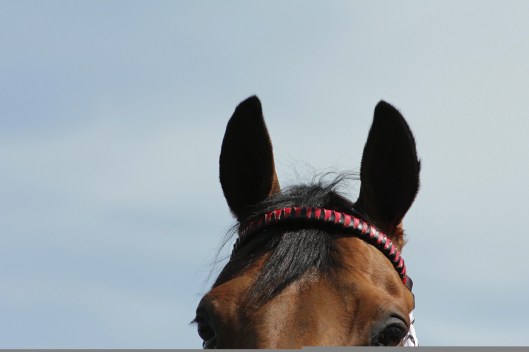
Focus
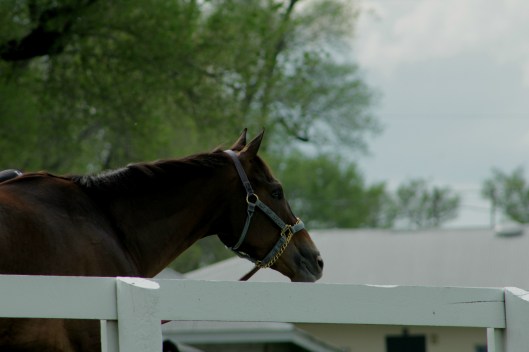
Heart to Heart
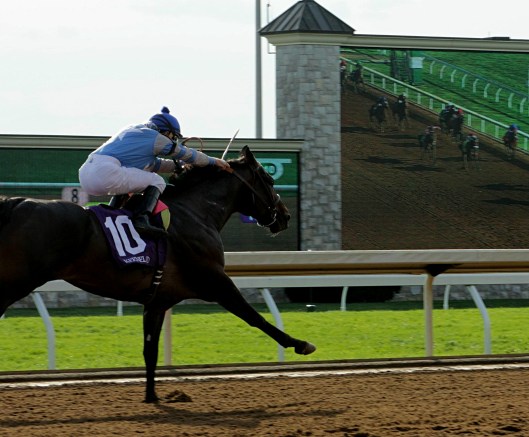
Drive to win
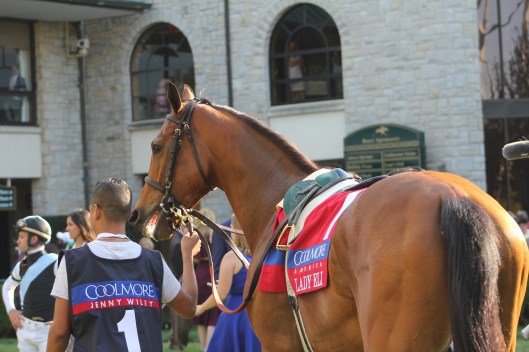
Lady Eli, the very personification of determination (and luck)!
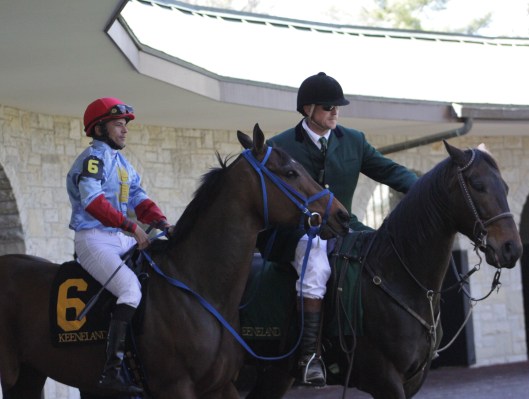
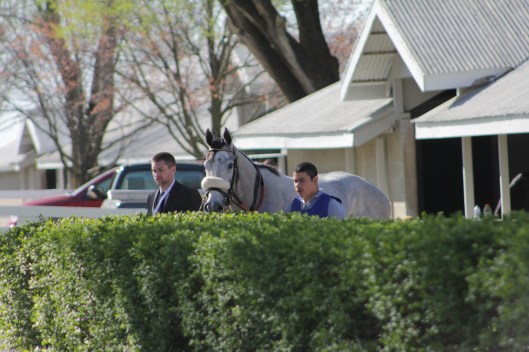
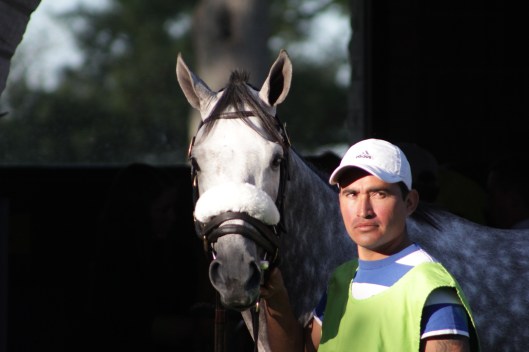
Mongolian Saturday escorted to the track ahead of the rest of field for the April 8 Shakertown Stakes. He finished 6th.
Constellation, who finished second in the Madison Stakes. It was my first glimpse of the Birdcatcher spots she has that must have cleverly inspired her name.
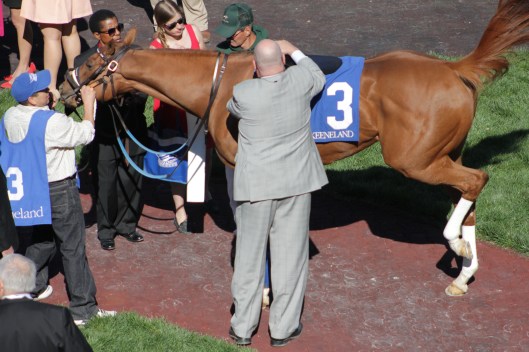
Kathballu being saddled for the April 8 Madison Stakes
Sailor’s Valentine, eventual winner of the April 8 Central Bank Ashland Stakes
Daddy’s Lil Darling, who I later became acquainted with. She truly is as sweet as her name suggests, and finished second in the Ashland. She is expected to run in the Kentucky Oaks.
Part of the field for the Ashland
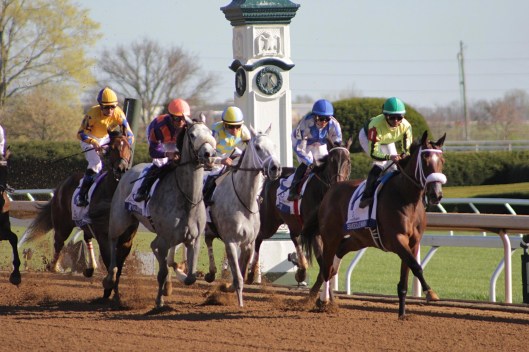
First time by in the Ashland, with Someday Soon leading the pack and eventual winner Sailor’s Valentine (#7) running in second place.
Ashland Stakes, first time by
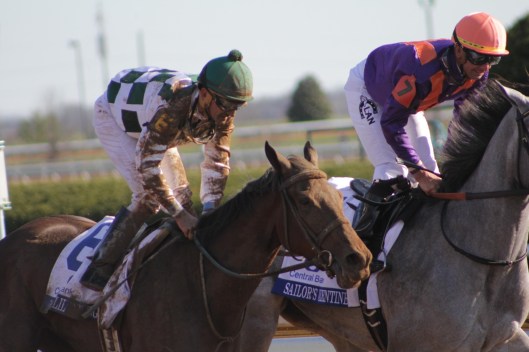
Top two finishers in the Ashland, Sailor’s Valentine and Daddy’s Lil Darling
Pretty City Dancer after the Ashland
Sailor’s Valentine nearing the wire for the victory in the Ashland
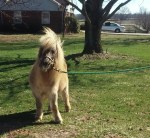
Looks like a blissful day for this pony
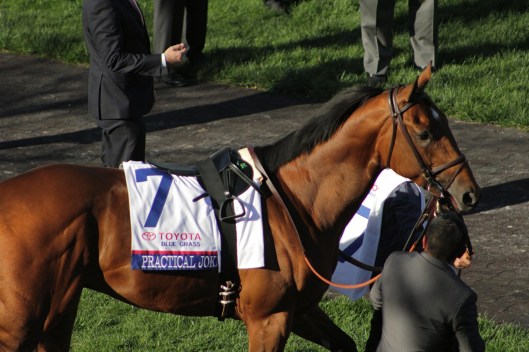
Practical Joke in the paddock for the Blue Grass Stakes
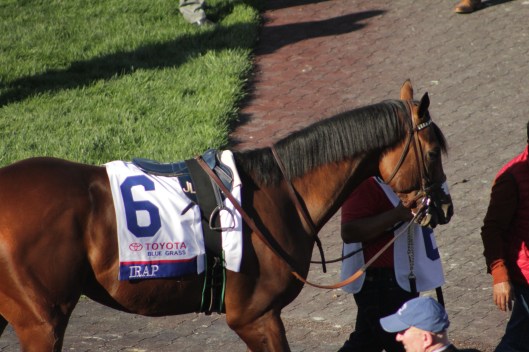
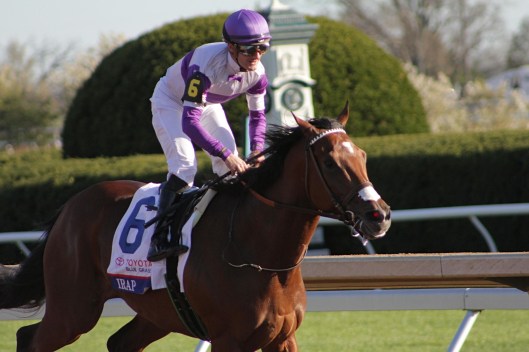
Irap, a half-sibling to Speightstown, and eventual Blue Grass Stakes winner
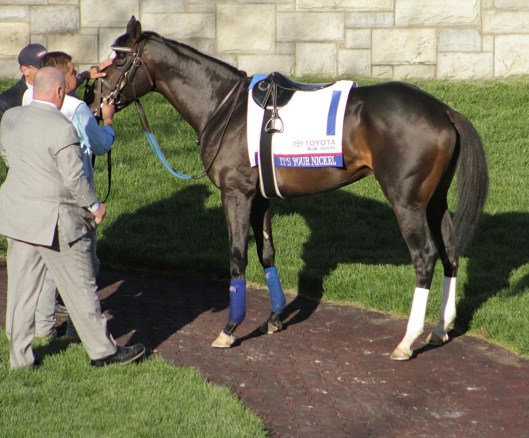
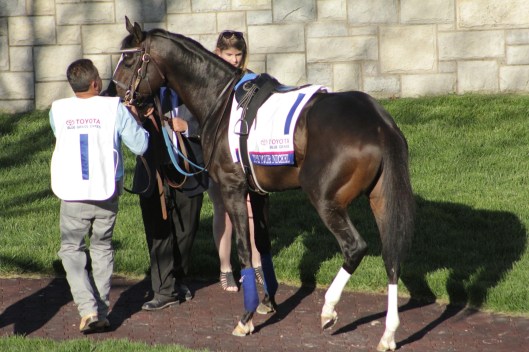
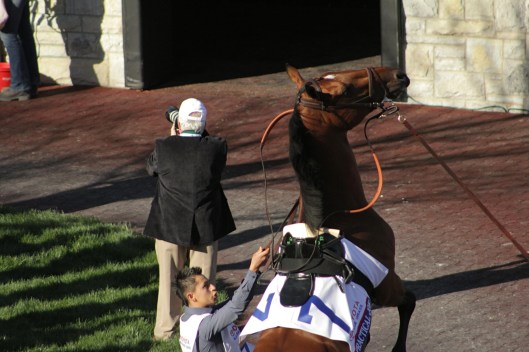
Practical Joke got a little antsy in the paddock and reared up, just as It’s Your Nickel did before him.
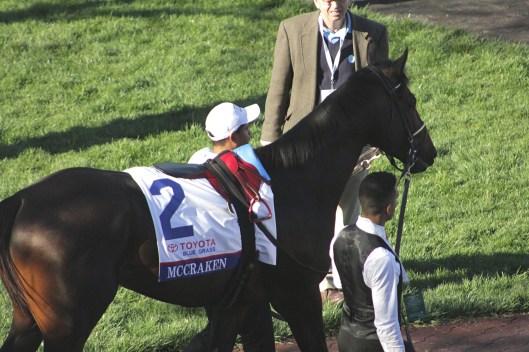
McCraken, undefeated until the Blue Grass, where he finished third.
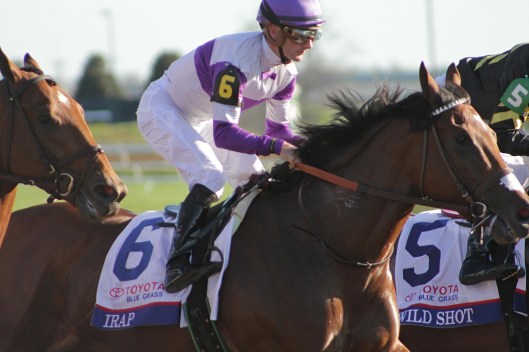
Irap, second in the early stages of the Blue Grass
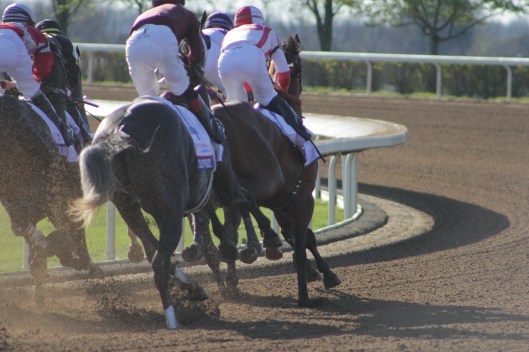
Into the turn for the Blue Grass
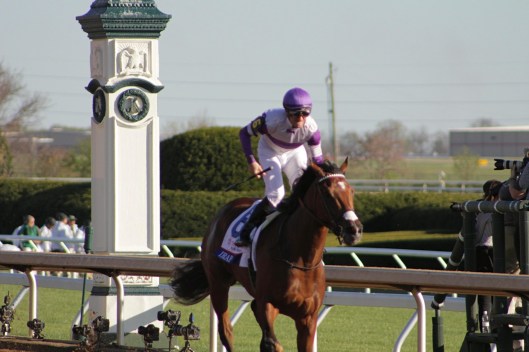
Irap past the wire in the Blue Grass, becoming the first maiden winner in its history
When the chestnut colt who entered this world 100 years ago today was foaled, it is natural to wonder if there was any inkling of how he would practically come to be the standard by which any racehorse would be measured. This can be asked now that we can look back on how his life and career unfolded, but when he was foaled that day so long ago the few brief lines jotted down about his foaling don’t reveal much more than particulars of gender, color and markings. Yet his pedigree spoke of the hoped-for potential possible for the young colt, with his sire being the highly-regarded Fair Play and his dam the daughter of an English Triple Crown winner.
While Man o’ War was born and lived before my time, I too see him as the standard by which all racehorses should be measured. I had only to read Walter Farley’s biography of him which brought him to life so vividly to be captivated. While considered fiction, it wove enough fact into the tale to be a good account of Big Red’s life and career.
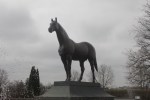
The celebration of the one hundredth anniversary of Big Red’s foaling began aptly enough in front of the life-sized likeness of him sculpted by Herbert Haseltine at the Kentucky Horse Park. The statue is a masterpiece–compared to photos of its famous inspiration, the proud stance and the head held high are very evocative of how Man o’ War presented himself to visitors over the years in retirement. There even seemed to be a freshly restored gleam to the statue’s eye that may have always been there prior to the recent application of a new patina, a gleam that also seemed to give a further glimpse of the living horse.
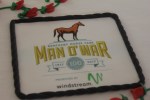
Ice cream created by Crank n Boom in honor of Man o’ War
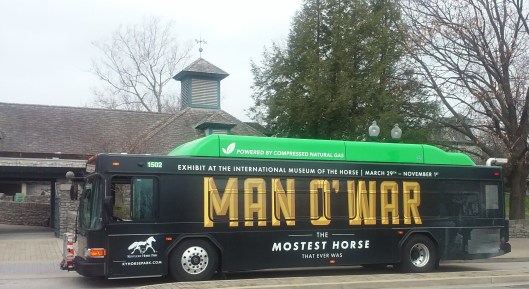
The entrance to the Horse Park’s new Man o’ War exhibit
An image from the Man o’ War exhibit at the Horse Park, which features memorabilia from many aspects of his life
For one historian, the day was a perfect time to share his personal recollections of Man o’ War, and I was as captivated by his speech as I had been by Walter Farley’s book about Big Red. The difference was, it felt like being even closer to getting a sense of who Man o’War had been as recounted what he had personally meant to him, particularly in regard to the day of his funeral. For many of us today, while revered, Man o’ War exists only in these stories, photos, and video. That is more than enough to keep his legacy alive, but only when hearing from someone who grew up in close proximity to “Red” can the truest measure of what he meant to people be fully realized. The historian (regrettably, I did not catch his name) had to take a moment to regain his composure when saying he and his father stayed on the outskirts of the funeral service, for they did not want to see Man o’ War in his casket or remember him that way.
I can understand. Any great horse should always live in our memories as “near to a living flame as horses ever get,” as Joe Palmer famously described Man o’ War.
The Horse Park showed a video about Man o’ War’s life, which had footage of him running with a burst of such power and speed in his paddock in retirement it engendered awe. The might of Man o’ War was truly incredible, and there is no doubt even 100 years later, he still deserves every bit of the accolade and to be the standard by which all racehorses are measured.
I never saw him in the flesh, yet for all those reasons and more, I know I will never forget him. I do sometimes wish I had been one of many who poured through the gates to see him in retirement, but much like Farley, Palmer, and the historian helped bring him to life for new generations, naturally his devoted groom Will Harbut has to be mentioned for perhaps burnishing Man o’ War’s already significant legacy possibly more than anyone else.
Therefore, it seems only fitting to close with his famous words that have stood the test of time in transmitting across the years what his charge represented to him and to all who came to visit.
“This is Man o’ War. He ran in twenty-one races and won twenty of them. A horse named Upset beat him at Saratoga when he was turned sideways at the start. He beat that hoss bad afterward. As a three-year-old he ran in eleven races and won them all. He ran a mile in 1:35 4/5 and broke the track record. He won the Lawrence Realization by a hundred lengths and set a new record. There wasn’t anything to run with him when they retired him to stud. He is a great sire; he sired horses that have won three million dollars. There was American Flag, Crusader, Mars, Bateau, Battleship, Clyde Van Dusen, War Admiral, and War Relic.
The year War Admiral won the Derby he had four sons that were champions. War Admiral was the champion three-year-old, Battleship was the champion steeplechaser, Blockade was the champion timber hoss, and Holystone was the champion hunter.
Folks talk about ‘second Man o’ Wars.’ There ain’t any second Man o’ Wars. This is the greatest hoss of them all. Nobody will ever know how good he was—there wasn’t anything to run with him. There ain’t ever been anything like him and maybe there won’t be ever again.
Man o’ War didn’t need no excuses. He broke all the records and he broke down all the horses, so there wasn’t nothing for him to do but retire. He’s got everything a horse ought to have, and he’s got it where a horse ought to have it. He’s just da mostest hoss. Stand still, Red.”
When Horse Country was launched to provide farm tours in central Kentucky, it was with the main purpose of bringing the stories of a signature industry to life for even more people.
There are few better places to to bring such a tradition of excellence in the Thoroughbred industry to life than at a farm with a legacy of 150 years of raising racehorses.
Runnymede Farm is tucked into and around a long tree-lined drive. The light yellow barns that dot the property are charming, and stepping foot onto the farm somehow imbues a visitor with a deep sense of history. Part of that is that you could almost see this farm being as it was in days gone by.
That is not to say Runnymede is antiquated. Like any top farm in this region, it has some of the best horse people and horses associated with it. It just seems to wear its legacy in a way that is indefinable, but best described by the sign at the entrance that reads, “Runnymede Farm, established 1867” – as far as records can determine, the oldest horse farm in existence in this country – and the litany of top horses that have come from this property and gone to racing glory. Their names are well known to any racing aficionados, names like Star Shoot, Miss Woodford (described as the “first Zenyatta” – winner of over $100,000 in the 1880s and dozens of races), and Hanover.
There was also an interesting story about how Roamer got his name, which I had never heard before. There had been a teaser and a blind mare on the farm, and no one is sure who jumped the fence into the other’s pasture, but the resulting foal seemed he should most fittingly have the name Roamer. Given his unplanned existence, Roamer went on to have an incredible racing career. The story was mentioned to point out how breedings can be so carefully planned and then one horse jumps a fence and produces a really good horse with no planning involved at all. Federico Tesio once told a story like that as well…
Runnymede, besides being a fount of quality nearly since its inception that is carried on to the present day, is associated lately with a horse of immense tenacity in Lady Eli. Her dam, Sacre Couer, grazed on a hill on the day of our visit, carrying her eagerly-awaited American Pharoah foal.
Speaking of the hills of Runnymede, their horses leave the farm wanting to run, evidenced by the number of graded stakes winners the farm turns out, and the hills and the condition they help the horses build from their earliest days of life are likely a strong contributing factor.
I realized the goal of any breeder or owner is to have a top horse, and that those horses that achieve graded stakes success are only a small portion of any foal crop, and the number of grade 1 winners is an even smaller pool. What I never considered is that means they are hoping for the outliers. That was an interesting way to consider it.
Brutus Clay, who led our tour, told us Runnymede has a great percentage of stakes winners and grade 1 winners, putting them among the top farms in the world. The statistics are even more impressive when it is considered that Runnymede usually has between 30-40 mares, and successfully holds it own with much larger operations. Quality speaks, and flows through the bloodlines of the horses that live there today just as it did through the bloodlines of the horses that lived there in the 1800s. It is incredible to think of a farm being in existence that long. Clay even joked that most people are asked what they did before they got into horses, and for his family for generations horses are what it has been all about.
Meeting the next generation was the order of the day after hearing of Runnymede’s history.
A young mare with her first foal, an Orb filly, was in the first pasture we came across. Her love of peppermints was so great that it was enough to lure her from grazing, and she followed one of the farm employees across the pasture to bring her and the filly closer to give the assembled group a better look. The filly was all leg, as foals are at that age, and there was charm in how she looked to be more leg than anything else and while she was quite agile, she stood in a way that made it look like she was still getting used to her own mobility. I had taken some of the day off work to visit, and it did me a lot of good to have time in nature and among horses again and the foals were a sweet bonus.
After that, we visited an older mare, Bloomy, and her colt by Uncle Mo. This foal led the mare to the fence, directly opposite how the first foal had been. The foal was pretty bold but the mare didn’t like the strangers getting near her foal and charged the fence, then kept him at a safe distance. This foal at her side was the last she would have, as she had earned her complete retirement after winning over $100,000 racing and being named 2012’s Pennsylvania Broodmare of the Year. She is 20 this year, and after her foal is weaned she will live out the rest of her days at her owner’s farm in Pennsylvania.
I had to leave sooner than anyone else, past fields of mares still in foal and a few yearlings in the pasture nearest the entrance. They were like the send-off crew concluding an enjoyable visit and interlude from the artificiality of the warehouse environment where I had stolen a bit of time from to reconnect to nature and horses, the essentials for my soul.
I recently attended a great program at my local library consisting of a BBC-funded film, “To Defuse a Bomb,” a documentary about Project Children, an organization that brought children from Northern Ireland to America during “The Troubles” to give them a respite and a safe haven for a summer. Project Children also brought together Protestant and Catholic children, often with the same host family, which was not possible when they were back home since they didn’t go to the same schools or live in the same neighborhoods.
As they said in the film, bringing together the children of different faiths planted a seed – when their families said negative things about the opposite religion from the one they practiced, to those who had been part of Project Children in America, they had a different view of the Protestant and Catholic divide. It meant to some of the Catholic children in Ireland, a Protestant was not a nameless, faceless “other” that it was easy to see as an enemy, and vice versa. It was a simple formula, and it didn’t always overcome the strife and unrest when those children went back to Northern Ireland, but it definitely made a difference.
One of the children interviewed for the film reiterated that when he said he didn’t picture a person who he didn’t know and who was too different from him to ever find common ground with. He envisioned the person he had known and lived with for six weeks in America. They fought at first on the plane ride over to America, and they were suspicious of one another when they ended up being assigned to the same family overseas. Yet they managed to put that behind them eventually, even as they knew when they went back home there was no way they could associate with each other. Yet neither forgot that the “other” was a boy much like himself, who liked swimming and baseball.
It takes more than that to overcome decades of strife among people split by division, but its successes were great. It expanded beyond the few cities where it began in upstate New York, reaching Washington D.C. and host families there. The two children who fought on the plane on the way to America and ended up with the same host family, two children that were some of the first participants in Project Children, ended up being lifelong friends who were best men in each other’s weddings and still visit their American host family frequently. They went back to stay with that family for years while growing up, and their host family had photo albums full of their childhood pictures. They became as much a family as their blood family in Ireland was.
It was also mentioned in the documentary that the opportunity for America to help intervene in a positive way to further help spread peace was started when Project Children expanded to D.C. and one of its organizers, a New York City Police Department bomb squad expert, was invited to the Clinton White House to be honored for his work with the bomb squad. After receiving his award, he was returned to speak to Clinton about the work with Project Children and the need to help the young people in Northern Ireland have a chance to escape the strife where they internalized all the war and animosity as normal, and played games that consisted of conflict and throwing rocks at soldiers and tanks in their neighborhoods.
Clinton paid a visit to Northern Ireland in 1995, helping to foster peace talks between the opposing sides. It was the beginning of the turning point in all the strife there.
The program concluded with live music by the band Gypsy’s Wish, comprised of one of the young men – Declan Cheara (McKerr) – who participated in Project Children while he was growing up, and his friend Andy Toman.
Like the young boys who were extensively interviewed in the documentary, McKerr was also introduced by explaining what a difference Project Children had made in his life. He and Toman had come over from Ireland just to participate in the program held that evening and the following one, and while visiting Kentucky, they also did some sightseeing.
They had visited Ashford earlier in the day and seen American Pharoah. It is well-known “Pharoah” is one of those horses that makes everyone stop and notice. I saw this first when he floated so effortlessly across the training track at Keeneland one October morning before the 2015 Breeders’ Cup, and the ripple of excitement his appearance generated was almost palpable. The star power evident in the very fiber of his being was harder to define, to quantify or explain, but that is fitting for such a rare individual as a Triple Crown winner. It was that star power, that wellspring of talent and the effortless motion of his gallop, that made everyone stop and watch and that made the excitement ripple through us all.
A similar measure of this palpable excitement – while we no longer see him in race training or actual races – has not abated at all among his visitors at Ashford. It strikes even the most illustrious breeders or owners, those who have doubtless seen many top racehorses to also be nearly starstruck and awed by what an amazing physical specimen Pharoah is. That too is fitting. I would hope a Triple Crown winner, especially after all these years of waiting, would still be regarded as exceptional. This possibly sounds like deification yet I guarantee anyone who has seen him in person understands the deep awe at being in his presence. It is nearly unavoidable.
It was interesting to hear McKerr’s impression about his visit with American Pharoah. I don’t know if he liked racing or followed the sport in Ireland, but knowing of him only in the context of a musician, it was intriguing to hear that Pharoah inspired him as well.
That is the gift of a top racehorse, and one Pharoah has achieved in spades.
McKerr said of his visit with the champion that American Pharoah looked like mahogany, a description that I loved. He also noticed how incredibly muscled he is. It drew me back to my first time standing next to Pharoah, and it was those things about his near-impeccable physique that awed me too.
Pharoah, in fact, had inspired McKerr to the point that he included a song about horses in their set that night. I guarantee, like any lucky enough to be in Pharoah’s presence in retirement or in his racing days, that McKerr will always remember too how it felt to see him in person.
You see, the difference coming to America as part of Project Children made to McKerr’s life – besides giving him a respite from the strife – was that he was drawn to play guitar, influenced by Jimi Hendrix and Carlos Santana. Much like Pharoah was in a class of his own when he ran, so was McKerr when he played guitar. He struck me as a near virtuoso, and getting to experience his incredible talent in person inspired me just as much as Pharoah’s did.
I once had thoughts of learning guitar, but put the lessons aside once I realized it would be difficult to master while trying to finish my degree and work full time, but this program made me want to pick it up once more.
Gypsy’s Wish, inspired by their visit with Pharoah, added the song “Ride On” to their setlist. I wanted to know more and looked up its lyrics afterwards.
According to the website songfacts.com, ” ‘Ride On’ was written by one of Ireland’s most famous songwriters….Jimmy MacCarthy….MacCarthy explained on Radio Eireann in February 2010 that this song’s lyrics hark back to his days as an apprentice jockey. When they first began training for races the younger horses would gallop behind the older horses. But as the younger horses developed, they needed the horses in front to go faster, so the jockeys would shout out ‘ride on.’ “
I think anyone who’s been at the track or watched horses in training has seen that moment when a horse exceeds what the competition can do if he or she has a future as a good or great runner. For some, that moment of top potential is evident early on, and that is how it was with Pharoah.
The song lyrics itself, while clearly directed to a person instead of a horse, were also reminiscent of the greats like Pharoah:
Sure you ride the finest horse I’ve ever seen,
Standing 16 one or two, with eyes wild and green
You ride the horse so well, hands light to the touch
I could never go with you no matter how I wanted to
Ride on, see you,
I could never go with you no matter how I wanted to
Ride on, see you, I could never go with you no matter how I wanted to
It was a fitting song to describe Pharoah and what he meant to them, and an unexpected intersection of racing and music – two of my great loves – in the same evening, and I appreciate the library for hosting it and the band for coming from Ireland to visit and share their talent.
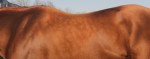
The handsome California Chrome at Taylor Made. He shone like a new penny as fans gathered to feed him cookies given out by the tour guide (no outside treats allowed) and was dappled, in excellent health, as seen by the photo of his torso. He covered his test mare quickly, getting right into the swing of things after arriving at the farm January 29, the day after his last race in the Pegasus World Cup, and has a full book of 150 mares for this season.
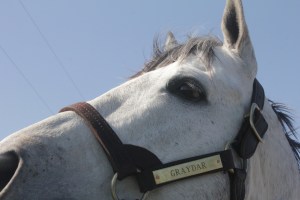
Nearby was Graydar, who also received some cookies and attention.
Then it was off to see some foals and a few two-year-olds who sold recently for over a million dollars.
$1.1 million colt from the recent Fasig Gulfstream sale
The filly below, by Uncle Mo, sold for $1.5 million. She has a very calm demeanor, much like I remember Nyquist’s being from when I tracked him around Keeneland and Churchill leading up to the Derby while writing for BloodHorse.
Our visit on the beautiful March day concluded at the gift shop, which will soon move across the street from the farm into larger quarters, along with a restaurant Taylor Made will operate, which should be open in time for Keeneland’s spring meet.
Note: This post was written on February 19, and the post title was inspired by a lyric from Paul Simon’s song “El Condor Pasa”
I vividly remember the first time I saw Charismatic in the flesh, though it was nearly 15 years ago. It was my first visit to Kentucky, to finally see as many of the horses as possible that I had watched race on TV.
Charismatic endeared himself to me in the spring of 1999 for the same reason he endeared himself to a multitude of people.
He was the classic underdog, a horse who had recently run for a claiming tag prior to his foray onto the Derby trail, a foray that led to him winning the Coolmore Lexington Stakes late in the Derby prep season.
His jockey was in the midst of a comeback when he got the mount on Charismatic, so the underdog horse and the “Comeback Kid” Chris Antley cemented their partnership with Derby and Preakness wins. The stage was set for the hoped-for dream ending in the Belmont Stakes.
For the handsome chestnut colt to win the Triple Crown for the first time in 21 years was not to be.
Instead, he and Antley left possibly an even more enduring mark in people’s minds and in the annals of horse racing. Anyone who followed Charismatic’s story knows all of these details, but it is part of his legacy and worth the re-telling.
When Charismatic sustained multiple fractures to a front leg during and shortly after the Belmont, the photo of Antley jumping off of his back to hold his injured leg off of the ground and stop Charismatic from running on it anymore remains vividly implanted in many racing fans’ minds.
Antley played a huge role in helping to save Charismatic’s life that day, and the colt went on to retire to stud.
While Charismatic helped get Antley back into racing after he took a hiatus from being a jockey, the return was sadly short-lived. Antley will always be remembered for his actions the day of the Belmont in 1999, as well for being a top-notch jockey. While he helped save the horse, ultimately he could not be saved from his personal turmoil. Antley’s life ended in late 2000, a loss that rippled deeply through the racing community and the lives of those who knew him personally. Yet his own talent and horses like Charismatic would always ensure him a lasting place in racing history.
Charismatic went on to begin his stud career at Lane’s End in 2000, the same farm where his sire Summer Squall stood.
That is where I met him for the first time. It was both a vivid memory and a bit like a dream, simultaneously.
It was vivid because I wanted to take in every impression of this horse who I rooted for to win the Triple Crown, and then just fervently hoped would live after his leg fractures. He had of course survived and that is part of why seeing him face-to-face also felt like a dream.
The other aspect that made that visit feel like a dream was finally getting to see all the farms, and all the horses that had only been images on a TV screen or known through articles until then. I began watching racing when I was about 9, and the chance to finally get to be in an epicenter of racing and breeding had been a long time coming.
What I sought from these visits and still seek when I go to farms was the connection with the horse, to get to know their personalities.
Getting to have that time to interact one-on-one with Charismatic was brief that day in 2002 but no less meaningful for its brevity. I got to feed him a peppermint that a groom gave me, and that was when the emotion at getting to see him and interact with him revealed itself. It was unexpected, but I suppose when a horse captivates you even through a TV screen and has you rooting for him the way I did for Charismatic, it shouldn’t come as a surprise. With slightly shaking hands I dropped one peppermint before I got to feed it to him, but when I did feed him the next one I was given, I remember how mannerly he was as he took it from my hand. There was a gentleness about him.
While the visit was short, the gentle way he took the peppermint remained a lingering memory of my visit to Kentucky. Lane’s End, I think, was the first farm I visited when I went to Kentucky that year, so Charismatic would have been one of the first horses I interacted with. That is probably another reason that first impression of being near him remains so vivid.
It seems like the little things sometimes are in fact the big things, as on the surface it was just feeding him a peppermint but underlying that was the connection I felt to Charismatic, a meaningful undertone to what was just a few moments in his life and mine.
As it turns out, I had visited him just in time, for he was sold to Japan for stud duty after his 2002 season at Lane’s End concluded.
I didn’t know if he’d return to the U.S. or even expect him to. When Silver Charm later went to Japan for stud duty too, I remember thinking maybe somehow I could go to Japan and visit them both one more time.
Thanks to Old Friends and a collaborative effort among the JBBA and the farms where both Charismatic and Silver Charm stood, as well as financial assistance from the Lewises and fans, seeing them again didn’t require a trip to Japan. Silver Charm, to my absolute delight – and Michael Blowen’s – retired to Old Friends first. After years of negotiations and waiting for his stud career to finish, Charismatic followed Silver Charm there in retirement in December 2016.
I eagerly followed Charismatic’s journey via Twitter, all through the long plane ride from Japan, to quarantine in Chicago, and finally to his van trip to Old Friends.
Charismatic was home – his long journey had ended and his full retirement had begun.
I waited just as eagerly for my chance to get reacquainted once he was out of quarantine at Old Friends. I first saw him there in December last year, shortly before the holidays. He was in a small paddock and still in quarantine. That didn’t allow for the opportunity to get reacquainted but I was just so glad to see him back that it didn’t matter.
In late January, I returned to see him out of quarantine, so I got to begin to know him again and feed him carrots. Our wonderful tour guide Lisa began the story that would be mentioned every time a group visited Charismatic. I took in every word, though I had already known about D. Wayne Lukas coming by the day after Charismatic arrived for a reunion with his champion, when he had commented that Charismatic looked so good he jokingly said he could still race him.
Charismatic did indeed look incredible, which was a testament to the care he received in Japan. The same had been evident with Silver Charm when he arrived from Japan.
That January day, Charismatic was in the barn and he was acting a little flighty. He was still getting used to visitors and his new routine. Yet even though he was adjusting to his new home and circumstances, he was still the same mannerly horse I remembered. He took the carrots from my palm as gently as he had taken a peppermint at Lane’s End all those years ago.
Not too long after that visit, he was given his own large paddock where Ogygian had once roamed. I wanted to have photos of him there as well, so I returned to see him on February 17.
He was in the barn again, but he had settled down since the previous month. It was apparent he was getting used to the Old Friends “carrots and visitors” routine and he didn’t toss his head or look a bit wild-eyed at the group of people clustered around his stall.
He stretched his head forward eagerly to take the carrots, yet for all his eagerness he was still as gentle about it as ever. I felt once more like taking in every bit of him, just as I had all those years ago at Lane’s End. I even looked over the leg he had fractured, since some of the visitors asked which leg it had been. It had appeared to be in impeccable shape in 2002 and this year, and x-rays taken when he arrived at Old Friends revealed the same.
And today, the racing world learned the incredibly sad news that Charismatic was found dead in his stall.
Who knew that the last time I saw him would be so reminiscent of the first?
I am glad he got to have time at Old Friends, to receive visitors, carrots, and affection, and to have a few months of retirement.
I am only sad that is was so brief, but initial accounts indicate he seemed to pass peacefully and that is a blessing.
His loss came sooner than anyone expected, and was shocking in its suddenness when he’d looked to be in such fine health and condition when I saw him, and when he was given a last bit of carrots the evening before he died.
I can only think what Old Friends farm manager said is true, something I had come to believe myself a while back… lottery time’s up and when it is your time it was your fate and nothing could have changed that even if it seemed easily preventable.
So Charismatic wasn’t claimed by a broken leg, a long grace period made possible by Antley’s quick actions and the work of vets. So he got to come home, to endear himself to more fans, and then to leave this life – it appears – as gently as he inhabited it, as gently as he took the treats from my hand.
I never got to know him well – his remaining time was revealed to be too short for that to happen – but I got to see that the acquaintance made with him years ago was starting to deepen.
Lisa, also our tour guide on my last visit with Charismatic, told us how Antley would never get to visit his former mount like several jockeys had been able to do. I shared my thought with her in January that in a sense Antley lives on through Charismatic, since Charismatic is part of his enduring legacy.
Now the comeback kid and the chestnut who blazed a trail through the classics in 1999 have both become memories – memories that for me and many others will endure as one of the most touching stories in racing.
Rest in peace, Charismatic. I miss your kind and gentle nature already.
The February 4 Holy Bull Stakes marked the beginning of champion Classic Empire’s three-year-old campaign as he attempted to begin his run and qualifications to be in the Kentucky Derby starting gate.
Irish War Cry, a son of Curlin, was sent to the front early when the race began, with Classic Empire staying in third early on.
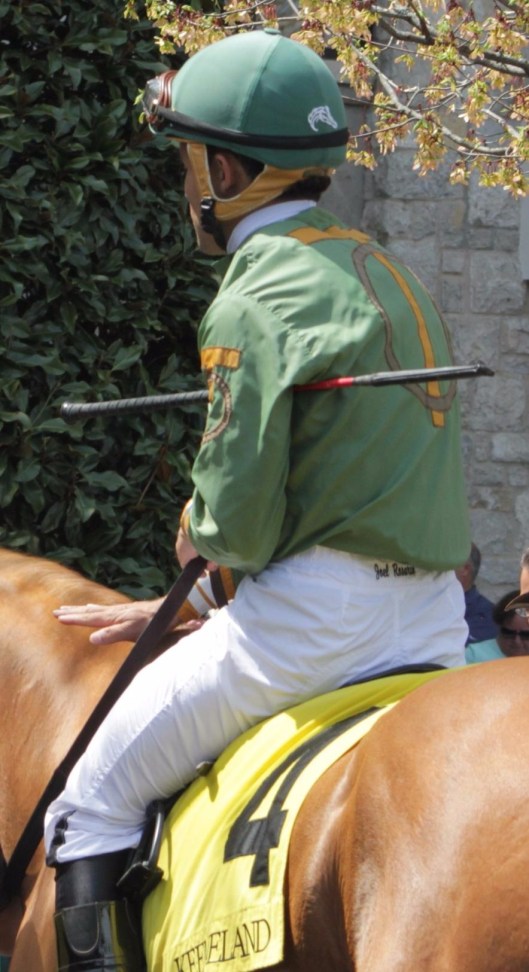
Irish War Cry began to draw away with a narrow margin over the Classic Empire and Talk Logistics just behind him, and looked like he was just waiting for the word to go. Classic Empire and Talk Logistics raced almost in perfect tandem at the half-mile pole and a bit beyond, but it became all Irish War Cry and Joel Rosario. Irish War Cry was full of power as he ran to the wire, finishing up with a lead of 3 ¾ lengths, and looking like he could have finished even further ahead.
Classic Empire briefly took second, before being overcome by Gunnevara to cross the wire in third place.
He was later found to have a foot abscess that was likely to have made him flatten out a bit and retreat from maintaining his second place position.
Irish War Cry certainly has put his name on the list of serious Derby contenders based on this victory, as the road to the first Saturday in May really gets underway. History shows, though, that with a narrow time frame until then that can be impacted by even minor training setbacks, injuries, or foot problems, it is too soon to say which top contenders at this juncture will still be top contenders in early May. This is not to knock Irish War Cry – he looked quite impressive to me in the Holy Bull. More to the point, especially considering the foot abscess, it is too soon to write off Classic Empire.
The Derby trail is always full of intrigue, twists and turns, horses vaulting into the picture or sliding down the ranks, and this year should be no different. I look forward to seeing where it all goes, as always. Hopefully Irish War Cry continues to progress well, and Classic Empire recovers well. It would be interesting to see those two meet again when both are completely in top form.
Royal Delta’s recent loss laid open a gamut of emotions among those who knew her in her racing days, worked with her in Coolmore where she was boarded upon retirement from racing, and fans who followed her avidly. That the loss was sudden and unexpected only compounded those feelings.
Foaling complications took her at the age of 9 – too young, especially for a horse of her caliber.
Coolmore, it’s well-known, is a key player in the world of Thoroughbred racing and breeding. Their farm in Ireland, where Royal Delta had lived since her breeding career began, and where she had been bred to Galileo three times, is one I visited in mid-2012.
You don’t have to visit to realize the standard of care given each horse residing on the property, from the stallions who have stalls in what appear to be their own individual barns, to the mares and foals. But having visited and seen the immaculate grounds, the meticulously kept barns, and the long paths lined with trees where the stallions are walked, it was evident how great the standard of care is, as one would expect at any top-notch farm.
I remember my visit there, the serenity of the property, and the reflection of the affinity for the horse that seems to permeate so much of Irish life, and I know without being told – though it was mentioned – that they did all they could for Royal Delta. They did it because she was Royal Delta, and because she was a horse in their care.
Her loss was just one of those inexplicable, unavoidable twists life throws out every now and then.
As reported by Coolmore, after Royal Delta’s three breedings to Galileo, the only one that resulted in a live foal occurred when she had a filly this year. The first time she didn’t conceive, and the second time she aborted.
Her filly is by all accounts healthy, the longed-for result in what should have been only the beginning of the next phase for Royal Delta. Instead, she is the sole direct genetic link to all Royal Delta was on the track and may be as a producer. With Galileo as a sire and a hard-trying, classy dam as a racehorse, with the well-bred Empire Maker as a maternal grandsire, a mix of great DNA is there to give this filly the chance to be a talented runner. What she becomes, this one tenuous link to Royal Delta’s legacy, remains to be seen. The best bloodlines don’t always shake out as hoped.
All the promise is there though: the promise that guides the planning of pedigree crosses, seeking potential nicks, and the dreams that can grow in morning training and hopefully transfer well to afternoon racing success.
But that is years away for Royal Delta’s filly, if it will be at all.
For today, we remember Delta in all her racing brilliance, for what she meant to us, and for the ride she took us on.
She had many shining moments while she raced, but the most special to me involves a day at Churchill Downs when my nephew and I saw her run. She didn’t win that day, but she stood out to him as a champion, and to me because I have a soft spot for top horses descended from Empire Maker. It was also my nephew’s first visit to a track, something I had wanted to introduce him to for a while. But if he ended up enjoying racing, I wanted him to enjoy it because that’s what he felt on his own and not because I overly swayed him.
My nephew was 7 when we saw Delta race on that night card at Churchill, about the same age I had been when being captivated by a horse and her story drew me in. He was drawn in naturally with no prompting from me, but with a strong boost from Royal Delta. I liked her a lot myself, but liked her more for drawing my nephew in and letting us both share a joy in racing.
When I heard of Royal Delta’s passing, I immediately thought of the moment my nephew discovered racing with her on the track before him even before what she meant to me came to mind.
We saw her soar on the track, and reveal all she was capable of there. Yet there’s still a sense that she was not given the opportunity to fulfill all the promise she could have achieved, and that’s what stings about her being gone.
Yet she gave us a lifetime of memories, and that can never be taken away. Rest in peace, Royal Delta. You are missed.




















 Called To The Post