I read today that the Arlington Park property was sold to the Chicago Bears, and the Churchill Downs Incorporated CEO Bill Carstanjen was excited about what that would mean for Arlington Heights. Perhaps a stadium coming to that region will be more lucrative than a racetrack. I won’t debate that or if it’s true or not. Carstanjen further commented on the sale of the property by saying the proceeds might be used to build another racetrack in Illinois. Build another racetrack in Illinois when a beloved track is already in existence there? I admit I don’t know the whole story since I don’t live in Illinois about Arlington Park’s continued operation being feasible without assistance like slots. I’ve heard hints it may not be. I do know that CDI is adamant that will not happen so there won’t be competition with a nearby casino it has invested in, and that is what is the track’s death knell.
Even if CDI has branched beyond the racing industry, racing is still their primary business. To hear that they will let another track be demolished so a casino can operate is a travesty. It doesn’t sit well to hear a CEO of this company say he is “excited” about a move that will be the end of Arlington. But to hear that the proceeds will be for another track, just so it is far from that precious casino? How could one think anything but that there isn’t much thought for racing if it becomes a hindrance to their other plans. That would be more understandable if they weren’t the operator of these tracks by design, if they operated in another industry and had a chance to acquire land racetracks are on. I can’t fathom selling lovely historic tracks to the highest bidder and undermining a racing circuit in the process.
But enough of that. First, the vent; and now to honor what Arlington will always mean to me.
When I visited, I was enamored immediately. I explored every bit of the track I could that was open to the public. I even went down to a basement level floor that seemed a bit more utilitarian that contained primarily offices. Yet even there the love of the sport and the homage to racing history shone. There was a large hand-made collage on one of the walls there filled with photos of horses.
Touches of elegance, like embossed decor reminiscent of a master sculptor’s work, were also found throughout the facility. There was so much charm and ambience.
I watched some races at the head of the stretch, and a band played there between races, and kids ran around in the open grassy field. It was a thoughtful touch, providing entertainment beyond racing to hold the attention of those who may not be enthralled by an entire day of racing but would still like to see it. It was one more example of attention to detail that can make a day out memorable, for it shows people considered the whole experience from beginning, middle, and end. And that is what made me think of wanting to share this track with my nephew in late July this year.
I looked back at my photos from that visit today. That’s the first time it hit me strongly what this track being gone will mean when that becomes reality.
I’ve faced some challenging times lately. I haven’t paused to think of this track’s end more than fleetingly because there was already enough I was working through that was less than ideal, and that would hit me with another sense of loss.
So I know what will remain are the memories of one perfect day there. No amount of corporate greed or demolition equipment can take that away. I will always be grateful I got to experience what Arlington Park was all about. It was everything a day at the races should be.
After an incredibly illustrious career that spanned years in a time when it is common to see budding talent in the racing world retire when they have only begun to come into their own, Monomoy Girl walked onto a van to begin the journey from Brad Cox’s barn at Churchill Downs to Spendthrift Farm in Lexington. But she gave every impression of not wanting to leave the racing environment, hesitating at the barn entrance and even retreating momentarily. It added a bit to the poignancy to the curtain call of her racing days, because a quick look at her stats shows if ever a horse loved to race it was her. Further study reinforces that, given that her competitive fire didn’t dim from one season to the next, and even long layoffs after setbacks didn’t alter her stepping right back into competition like she hadn’t left, most notably in 2020.
And it is a testament to the care of everyone involved with her, as has been noted elsewhere, that giving her breaks from racing contributed to her being able to stay at the top of her game, in addition to how racing was in her veins like one would hope it would be with any promising horse that arrives in a barn.
While 2021 did not play out as hoped, it didn’t matter, for it was wonderful to see the mare who had become known around her barn as the Queen return to the track.
She last ran in April, on the comeback trail once more after another break for minor setbacks. While she wasn’t going to be in the gate for the Breeders’ Cup, I eagerly awaited the news of where she would race and hoped it would be close to me. I had followed her career since she was a 3-year-old awaiting her turn to run in the Ashland at Keeneland and see if that led her to Kentucky Oaks glory, which it did. It was thrilling to see her victorious in her first race after her layoff last year, coincidentally on my birthday, and then finish that season with a resounding Breeders’ Cup Distaff win. Then Spendthrift bought her at auction and worked out an arrangement to lease a portion of her 2021 racing rights to My Racehorse to make available to shareholders. I jumped at that chance to be even in a small way involved with the horse I’d admired for years. And that is why I couldn’t wait for her next race this fall, to try to have the perks My Racehorse offers for shareholders that would probably mean more with Monomoy Girl than any other horse, like lotteries to be in the paddock prior to her race and other race day hospitality.
But then, it was over. While it was unfortunate her attempted return was cut short by a non-displaced fracture, the main takeaway was she would not need surgery and her connections did the right thing by her as they always did. Though they noted she may have been able to come back from that, she had raced longer than many of her contemporaries ever did, and she didn’t owe anyone anything. There is a moment, when retirement is sudden, that adjustment from hopes of what might be achieved yet have to be slowly released. It is bittersweet. But above all, there is gratitude for seeing such a bright star.
On a balmy fall day, when the wind blew briskly through the trees, Monomoy Girl walked forward to the van she had initially hesitated to approach. I have no doubt she had felt that competitive fire again and was not ready to walk onto another van without a race to help quell it. And when I saw that, I thought of the line from the song “Angel from Montgomery”:
“Just give me the one thing that I can hold on to”
That has been the racetrack for Monomoy Girl, and for those who admire her, know her, and care for her, she has been there “to hold on to,” about as sure a thing as the racetrack can have. And maybe in a uncertain world facing a pandemic, “one thing to hold on to” means even more.
This is not meant to sound like a eulogy for the star mare, though it may have veered to that territory. It is more that the emotion of seeing her leave the track caught me off guard for how she was reluctant to go. It is not a requiem for Monomoy Girl, at all. It is a gentle goodbye to the career she had.
She arrived at Spendthrift in the afternoon, looking phenomenal, fit and gleaming with health and appearing to crave the grass before posing tall and proud like the Queen she became known as. It will be a beautiful retirement, in the lush pastures and in the sun, running for her own whim.
And I look forward to meeting her when she acclimates, as Spendthrift has graciously offered to those who bought lease shares through My Racehorse. The curtain rises on the next chapter, which will include an Into Mischief foal if all goes as planned.
In a 1970 interview, Peter Burrell spoke of his observations about racehorse breeding. As the director of the National Stud in Newmarket, England, for seven years by that point and a Thoroughbred owner and breeder himself, Burrell was well-qualified to remark on solid theories for successful breedings and even why the formula to create a top-notch racehorse was difficult to formulate or duplicate, even as many breeders attempted that feat.
I once visited a farm in central Kentucky where the stallion manager mentioned that every attempt to produce a top racehorse is breeding for an outlier. Even knowing how tall the odds are stacked for a horse reaching the upper tier of racing just to be competitive at that level, alone become a graded stakes winner, I had still never considered it in terms of breeding for outliers but of course that is what is happening. And that is why any breeder involved long enough realizes the element of luck has its role as much as good planning, given that even full siblings to top horses may not have anywhere near the talent of a more illustrious horse produced by the same sire and dam.
Burrell elaborated upon that outlier thought I heard a stallion manager express, and it was interesting to read his observations from his 1970 interview. The question posed to him in the interview was specifically about difficulty in breeding a Derby winner, which is 1 1/2 mile race in England.
Burrell answered, “The Derby distance and course require a very special kind of horse. It is the distance, really, I think, that is so crucial. The nub of it is this: it is comparatively easy to produce horses that can go really fast for distances up to a mile, even up to a mile and a quarter. It is also comparatively easy to produce horses which will stay distances of two miles or more at a good pace. But what you are asking here in a Derby winner is a horse who can go very fast for more than a mile and a quarter. A good Derby winner can sprint and can stay a mile and a half. You are asking, therefore, for a very special, a very peculiar type of animal.
Now this is where the natural processes insist on coming into the breeding process. With all animals, nature is always trying to produce a norm. When the breeder mates a sire and a dam whose combined qualities give him the peculiar progeny he requires to win the Derby, nature, as usual, steps in and tries to arrange that the progeny are not peculiar but revert to normal type. This is the probable reason for the disappointing results from mating Derby winners with Oaks winners. A possible method of breeding for the Derby would be to put a sprinting mare, let us say, to a staying stallion, hoping to produce a great intermediate. The records show that overwhelmingly the chances are that those two animals will produce stayers like the sire, sprinters like the mother, or something not very conspicuous between.
…In your quest for a Derby horse, which is in a sense a freak horse, nature is working not with you, but against you. This is the process known as ‘retrogression to the mean.’ “
Reading Burless’ comments, which he said had basis in scientific principles that could have been elaborated upon further but basically boiled down to the retrogression statement above, it made it more evident how extraordinary it is when a horse like Man o’ War or Secretariat comes along, given nature’s “preference” for a horse to be ordinary. Perfect still, to be what the species is intended to be, but not necessarily what a racehorse breeder may have hoped for. And yet, some breeders have still found better than average success with certain crosses in producing a fairly consistent number of outlier horses. As a pedigree enthusiast, it is intriguing to read of insights into breeding like this.
Another point I found worthy of reflection was made by James Gill to conclude his book Bloodstock: Breeding Winners in Europe and America. He wrote, “People engaged in the breeding, training and riding of horses are forever telling the punter that his sport is really an industry, as, indeed, he knows it must be, when, year in, year out, he sees all the good three-year-old colts syndicated by their prudent owners and packed off to stud in the hope that they will sire other horses too good for all but the briefest racecourse careers. Yet, not so long ago, Paul Mellon and John Hislop showed that it is still possible for sporting owners of great horses to achieve on the track a glory which will live in the racing man’s memory long after he has forgotten the dreary succession of half-tried colts dispatched, on accountant’s orders, to the stud. The day the grey men convince the public that racing is an industry, pure and simple, is the day that it will die. And then there will be some hard-up breeders.”
Reading Gill’s comment, it is definitely more common that top horses are retired young to perpetuate the breed, hopefully. Those will naturally get noted more because they attract media and fan attention. With racing at all levels, from claiming to graded stakes, there have to be horses running beyond age 3. No immediate future for them in breeding, supposing they are not geldings. So, it does not seem that this trend of retiring many top horses young is creating hard-up breeders. I’ve also seen evidence of how slim the profit margin can be even in top stables from race earnings alone; it is not an easy business to make ends meet in and it is possible standing a promising young horse will pay greater dividends than racing him.
And, as much as fans identify with top racehorses to feeling a marginal sense of ownership borne of affection, it must be remembered these horses are private commodities and owners don’t owe it to racing to keep them in training if insurance costs and risk outweigh reward. I too greatly appreciate when horses have long careers like Whitmore, Cigar, Monomoy Girl, and Zenyatta, purely from a fan standpoint. It is truly one that seems to identify racing more as a sport than an industry (especially given that often such moves as racing horses beyond age 3 can be referred to as a “sporting gesture”); even so given the value of horses at the top level there is no doubt it is an industry. Most owners love to see their top runners have fan followings, but economic realities dictate having horses race beyond three is not always practical. Still, I identify with what Gill wrote. When a horse appears to just be coming into his own and enthusiasm has built with each race, it is hard not to miss that horse on the track and wonder what further heights he might have reached. I always look forward to progeny of horses I liked but it is still hard to top getting to cheer on a favorite horse through more than two seasons of racing.
Sources:
The Faber Book of the Turf. Edited by John Hislop and David Swannell.
Bloodstock: Breeding Winners in Europe and America. James Gill.
When I read today in horse racing publications of B. Wayne Hughes’ formative years, it was easy to imagine his ambition and work ethic gave rise to dreams of what his life might be. He parlayed that work ethic into tremendous professional success, and then turned to horse racing. The revitalization of Spendthrift Farm, the rise of Malibu Moon and Into Mischief, the success of Beholder and the Derby victory of Authentic were dreams anyone involved in horse racing would love to see realized. But more than that, Hughes brought as many people along for the ride as he could, people who perhaps otherwise may have been on the sidelines of involvement in racing. It seems one from modest beginnings, such as Hughes, was ideally suited to realize what a gift that could be, to share his success and see it grow into dreams for others.
While I never knew him personally, I have seen firsthand what his influence in the racing industry meant. I went to the University of Kentucky in pursuit of a degree in Equine Science and Management, spurred by a deep-seated passion for racing. During the course of earning that degree, I was an intern at a smaller breeding farm where a client’s mares were boarded and managed. No doubt this client had dreams of racing success, even as she had to pursue them with only a few mares. Spendthrift Farm’s innovative breeding incentives made it a clear choice for several of the mares she owned to visit and that was my introduction to what such an approach meant to breeders who wanted to make a go of being involved in racing but couldn’t buy the top mares or visit the A.P. Indys. I accompanied one of those mares to the Spendthrift breeding shed. It had been the first day of spring, more than a handful of years ago.
More recently, I paid a visit to Spendthrift’s training division, Silver Springs, to meet a yearling American Pharoah filly out of Keertana, who would be named American Heiress when the time came to select a registered name. The occasion of meeting her was part of the continuing evolution of Hughes embracing ideas that would bring racing involvement to greater numbers of people. He made a commitment to MyRacehorse and from that time of it involving a few yearlings, it spread to encompass involving people in microshares of Authentic, already a top 3-year-old when Spendthrift acquired an interest in the colt by their own stallion Into Mischief. From there, Hughes further dove all in to supporting MyRacehorse, offering a multitude of yearlings they purchased at auction in partnership.
The chance to be involved even in a small manner with the progeny of American Pharoah, the first Triple Crown winner in my lifetime, was irresistible. But more than that, the photos of the filly sold her. Yes, I was smitten and the lure of what could be was strong.
That same lure – of what may be – drove the interest in Authentic, and when he won the Derby it was elation of a rare type, and now that I think of it, which most often were brought to me by the highs of racing. And the other side of that is, as for many, 2020 was a rough year. Authentic was the only bright spot of that year, and I will always be grateful to Mr. Hughes for thinking yet again of how to make the dream accessible.
When Authentic went on to win the Breeders’ Cup Classic and then arrived at Spendthrift shortly after to begin his retirement from racing, I watched on a live stream as Hughes stepped forward to greet his Kentucky Derby winner and his pride was evident. It was another shining moment of what that horse and this sport mean to many.
I think what a good life that would be to have lived, one where lofty dreams were realized that brought immense joy and where there was a commitment to share that joy.
It was a beautiful summer evening as I thought of these things. I went outside with my cat and he chased a stick I dragged along the ground. His exuberance at simple pursuits reiterated that we don’t need much of what advertising and so many other forces try to tell us we need. I found joy in his joy, in the moments in nature and away from phone or computer screens where so often people just seem to bicker and spread negativity more often than not. And those things, like seeing him chase the stick and finding joy in his joy because it was born of caring for him, and seeing Hughes’ happiness in taking in Authentic as he arrived at Spendthrift late last year, are simple but also real life. I need reminded to unplug from the wired world as many do but it is so much more meaningful when I do. Seeing Hughes’ dedication to racing and spreading the thrill of it to others, and seeing my cat delight in playing and how it uplifted me, reminded me that the best thing we can ever do in this life is love and share that love. That is the best impact a life can make. I know when my time comes, I will be glad people and animals I shared my life with will know that I was there for them and I will be grateful to have known what it means to feel that in return.
So, though I did not know Hughes personally, his love for racing and wanting to share that love made his life have a deep impact upon people he never met. I think of his family this evening, and how they are without him in the living world. Such a loss must reverberate deeply if he left such an impact on those who never knew him, and it is sad. But there is an indelible legacy such a life has left, and there is no doubt people’s lives were enriched because of him.
Heartfelt condolences to his family and friends, and those who were impacted by him professionally; I’d imagine they will feel this void for a long time. I’ve gone through the grief journey myself several times in the past few years, and when I thought I’d never get past how all-consuming it is initially, time gradually made happy memories of times shared eclipse sadness. Never fully, no, but more than once seemed possible, and I wish that for all who knew Mr. Hughes, too. In due time.
It tugged at my heart, as it must have for many whose lives have been impacted by Thoroughbreds, to read of Galileo’s passing at the age of 23.
Of course, he cemented his legend status long ago. Today I saw a replay of his first race, shared in honor of his brilliance that was evident from the start as he reached the wire ten lengths in front. It was almost too easy for him, and the heights he reached and the mark he left on racing and the lives of people who knew him, only grew from there. He excelled as a sire, as one could hope a horse from such a top-notch family would.
In May 2012, he was fourteen years old and well established as a stallion, in the midst of a seven-year run as Britain and Ireland’s leading sire. I point out this time frame specifically as it when I was fortunate to have my path intersect with his at Coolmore Stud in Ireland. I was there for a course, Horse Health and Management in the Emerald Isle, and part of the curriculum was visiting the renowned farm. Our instructor for the course had a professional background with horses and managed the itinerary and assignments, and another instructor who was not horse-oriented traveled with us to manage other aspects of the course that were not related specifically to what we learned, like travel arrangements and if there were any issues with those or with people in the course. It stands out in my mind that though she did not have a horse background, it awed her to be in Galileo’s presence. I think that alone speaks to what people saw in him.
I was naturally awed as well. He was led down a tranquil path and led back and forth several times near the stallion stalls which looked like individual barns, small, but not connected as one unit. He had a small protrusion from a colic surgery but it did not diminish his looks or the effect of his presence. In fact, it seemed a reminder of what he had endured and that is was good he was still alive and well. My primary impression of him besides the awe, which probably evoked it, was how he carried himself. Self-assured. Calm. Almost stately. I would say, like many great horses do, he almost sensed that he was a cut above many. And if horse herd hierarchy has anything to do with it and being descended from a multitude of superior horses that imparted that sense of dominance, he probably did sense that in the way a horse would, not with arrogance like a human may but just that unshakeable notion of his place in the world.
I will always be grateful that visit with Galileo was possible. And for that, I respect any request Coolmore made, but I couldn’t help but be curious why they told all present from my class not to share the photos of him we took that day, as I have seen others visit and share photos. And our instructor made it a condition of passing the course, to ensure we honored it, saying she would immediately fail anyone who did. Hearing the request directly from the stallion manager was all I needed to hear, and to this day I have kept those photos unshared publicly and likely will continue to do so. Yet as I look back on that it strikes me now if anyone did decide go ahead and share those photos, the consequences of failing a class that occurred in another country could well have been more significant than a bad grade on a college transcript. It could well have meant effectively unenrolling from the course and having to go home early and not via the flight already paid for. Not worth it!
A few years later, I went back to Ireland by myself for the first time, in a visit coinciding with Irish Champions Weekend, two stellar days of racing at Leopardstown and the Curragh. Galileo’s son Churchill won the Vincent O’Brien National Stakes, a Group 1 race for 2-year-olds. It was the colt’s first attempt at a Group 1 race, and as I look back at his race record, I think how amazing it was to be there one day to see a horse of his caliber. That type of runner is every bit of what people hope for and frequently got from Galileo.
Churchill won all but his maiden at age two, and burst through with a victory in his second career start. He was not quite the same at age 3, winning twice in seven starts, but he was a horse that anyone would be glad to have in a racing stable.
Not long after that trip to Ireland, I began freelance work editing the Stallion Register for BloodHorse. While the idea was to proofread as quickly yet as accurately as possible, the first time each year I worked there I came across a page featuring Galileo, it was a marvel at how long the list of current year’s stakes winners would be for him. For most stand-out stallions, 3 lines of black-type winners looked significant. Galileo’s list for the year would reach paragraph status, without fail. I think the way I paused to note that was a link back to seeing him in Ireland, and encapsulated a small bit of the awe I felt seeing him.
So one part of his story came to an end on July 10, 2021. And because of the awe he evoked in me on several levels, that is why I felt the tug at my heart that reading of his passing left. There is a void from such an ending.
But also there is the knowledge, as evident as the way Galileo carried himself that strongly suggested he knew his greatness, that such a being leaves a tremendous legacy that will endure beyond the time he physically existed. In fact, his son Bolshoi Ballet showcased that, as no doubt his descendants will for years to come, by winning the Grade 1 Belmont Derby Invitational Stakes the day his sire passed.
I know that feeling of gratitude at being in Galileo’s presence will remain with me.
Having recently read Give A Man A Horse: The Remarkable Story of Patrick Hogan, by Dianne Haworth, I was struck by the somewhat parallel paths his professional ties to the Thoroughbred industry took with Alice Chandler’s, and that the link was even stronger for involving her stallion Sir Ivor.
Much has been written about Sir Ivor resulting from a breeding of Sir Gaylord to one of four mares Alice Chandler’s father left her, and how he went to become an Epsom Derby winner, marking a grand start for her taking the reins and adding to her father’s legacy admirably.
Patrick Hogan and his brother jointly managed the Thoroughbred farm their father had begun when the latter passed away, until their paths diverged and Patrick Hogan went on to start his own farm.
After securing his own farm where he took broodmares he owned, Hogan began looking for a stallion to syndicate. After a long search without finding a promising prospect, Sir Tristam, by Sir Ivor, came to his attention. The horse’s race record was modest but his pedigree caught Hogan’s attention.
Speaking of parallels to Alice Chandler and Sir Ivor, Sir Tristram left Europe to try to contest the 1974 Kentucky Derby, whereas his sire had been American-based and captured one of Europe’s most renowned Derbies. Rayond Guest, Sir Ivor’s owner, also owned Sir Tristram during his race career. Like many owners in a position to dream of top racing glory, having a Derby winner was a deep wish Guest had. Sir Tristram’s American race debut was not auspicious, as he ws not familiar with the layout of U.S. tracks, and he ran 11th in the Kentucky Derby.
Sir Tristram was a tough horse to handle, often attacking people, and when he arrived in New Zealand after quarantine, he had been through a barn fire that left marks on his coat. It didn’t sell him well to syndicate shareholders in his intriductory show to them. It was reflected in mares he covered being a smaller amount than was originally planned, and in the quality of mares sent being markedly insignificant.
Hogan’s faith in the horse did not waver, however, and he sent his best mares to his court. It didn’t take long to see that this faith would be rewarded as some of his first progeny to hit the track and do well amassed over 1 million Australian dollars in stakes earnings, though they had a combined price of $12,000. That success captured the eye of people who perhaps would not have given sir Tristram a second glance before, and he was a six-time champion Australian sire and four-time champion broodmare sire.
He sired Zabeel among his dozens of Group 1 winners, and Zabeel became his heir apparent at Hogan’s Cambridge Stud. Zabeel did not commence his stud career at Cambridge until it was clear Sir Tristram himself was nearing the end of his sire career, as Hogan held him in such esteem that he essentially wanted the stallion ranks of the farm to encompass only one horse, the horse he affectionally called “Paddy.” (As a side note, as Patrick Hogan began to look to the future beyond encompassing bringing in a new stallion, it seemed unusual to me, given the time frame was the late 1980s, that he noted he didn’t have heirs to pass the farm to, as his children are daughters and not sons).
Zabeel did indeed take up the mantle well of his own sire, producing such top horses as Octagonal and Might and Power, to name a few. Octagonal sired Lonhro, who became a champion Australian sire in his own right, carrying on the legacy of the mighty Sir Tristram, with his intriguing mix of European and American influences that marked the beginning of an incredible chapter for New Zealand’s Thoroughbred history.
I greatly enjoyed the well-written book by Haworth that recounted this story, and how it brought to life Sir Patrick Hogan, honored with a CBE in 1991 for services to racing, and Sir Tristram, stories I had never heard before and that I appreciated adding to my knowledge bank as one interested in racing history and how pedigrees weave their way through this and add to it. This is but a small glimpse of what Hogan did for the racing industry. He is a remarkable individual and I highly recommend this book to anyone interested in racing.
Churchill Downs marked the closing day of their spring meet with the Stephen Foster Stakes and a handful of other stakes races, attracting the likes of Letruska and Maxfield.
The forecast originally called for thunderstorms but the temperatures soared up to the 90-degree range and the sun was out in force all day. The buckets of water poured over many of the horses post-race looked extra refreshing as my seat was not under a roof, but I still enjoyed the day immensely. It is wonderful to get back to race attendance and not miss all the big days. This could sound trivial to some in light of a pandemic, but when it is part of the fabric of who you are, it matters to have some normality to the rhythm of your days. I also enjoyed seeing two of Gun Runner’s progeny race, as not being able to go to sales last year meant I did not get to see any of the horses he sired. I do like to get a look at progeny of horses that were favorites on the track. so I appreciated that I had the chance during Churchill’s card.
I started my day in Louisville with a quick stop at Wagner’s, as I had arrived a few hours before the races began before moving on to the Derby Museum. In a typical, non-pandemic year, I attend the Derby and then don’t come back to Churchill until Stephen Foster day. But in 2019, if memory serves, I went to the Derby and no other race days at Churchill for that year’s spring meet. The gist of that is, I don’t know how soon after the Derby the horse model in the Derby Museum is repainted to look like the newest Derby winner, but when I was there on that day in late June, it was still painted like Authentic. The film about the Derby, which usually highlights the most recent Derby winner also, still most prominently featured Authentic’s victory. Later, at the track, I saw Medina Spirit’s name above the paddock and around the wall in the line with all the other Derby winners but it was not lost on me that they had not yet done anything to commemorate what at this time still stands as the official result that would be more time-consuming to do over if necessary, like updating the Derby Museum film or painting the horse there.
It did make me wonder how they showcased the 2019 Derby result in the film; naturally, the race call is very much of the moment but since that result did not stand, I wondered if they put text along the bottom of the screen to note Maximum Security was not the official victor or if they just played it as it was called during the running with no comment. I’ll be curious to see how they show that film if Medina Spirit is at some point disqualified.
Another point I wondered about during the showing of the film, as I listened to race calls echo through the years of a multitude of past Derbys was when it became possible to have race callers, as far as when sound systems that could carry sound to large groups of people were invented, and if prior to that attendees had to just try to see for themselves how the races unfolded. They must have had to.
I did a little research into that and figure one can only hypothesize how early race days were, and that the most likely conclusion is anyone in attendance just had to follow the action for themselves as best they could. But I did discover a little about sound systems:
“Up until the late 19th century, all forms of public address were done using architectural acoustics – there was no viable alternative to improve speech comprehension. However, the first step towards completely changing how people perceived sound came in 1875, when British-American inventor and music professor David Edward Hughes invented the carbon microphone…. The carbon microphone contained two metal boxes and worked by sound waves striking its diaphragm, causing the carbon granules contained inside to vibrate… Hughes coined the term ‘microphone’ to describe his invention, as he saw it as the audio equivalent of the microscope. Thus, the first component of a modern-day PA system was born.
A couple of decades later, the world’s first experimental moving coil loudspeaker was invented by British physicist Oliver Lodge. Known as the ‘bellowing telephone,’ this invention contained the same basic features as today’s loudspeakers – a diaphragm vibrated by a voice coil, the sound of which was then amplified by a flared horn.”
These inventions and an electrical component made it possible for people to address large numbers of other people by the early 1900s, and as a friend discovered, Churchill Downs had their first track announcer by 1940, Gene Schmidt, which means almost every Triple Crown winner has had the first step of that journey commemorated with a race call.
Before leaving the Museum, I took a little more time to see some parts of the exhibit about female jockeys I had missed last year. There were several interviews showing about aspects of their careers and two interesting points made I had never considered. One was when a jockey went to a trainer who was not giving her rides on his mounts, and she told him she would not have a strength disadvantage competing against male jockeys because she could eat substantial meals and still make weight, and not have to spend hours in the sweat box. Two others, including Rosie Napravnik, mentioned that when they had opportunities to step up and ride in more prestigious races or even just more renowned tracks that routinely had top jockeys ride there, it was a necessary step to advance their own skills by learning from the better jockeys and also learning in the moment how to become better. One of the jockeys mentioned that it was much more competitive than where she had been riding and the jockeys rode in tight quarters. That was something to mull over, and wonder if there were many more top female jockeys that may have been great at what they did but were not given enough opportunity to hone their craft to make the transition from good to great. Still, none of them complained about bias or missed opportunities. I gathered like any jockey of any gender they grabbed the chances they could to advance when they presented themselves and felt the track life was a calling and were glad to be part of it even on hard days.
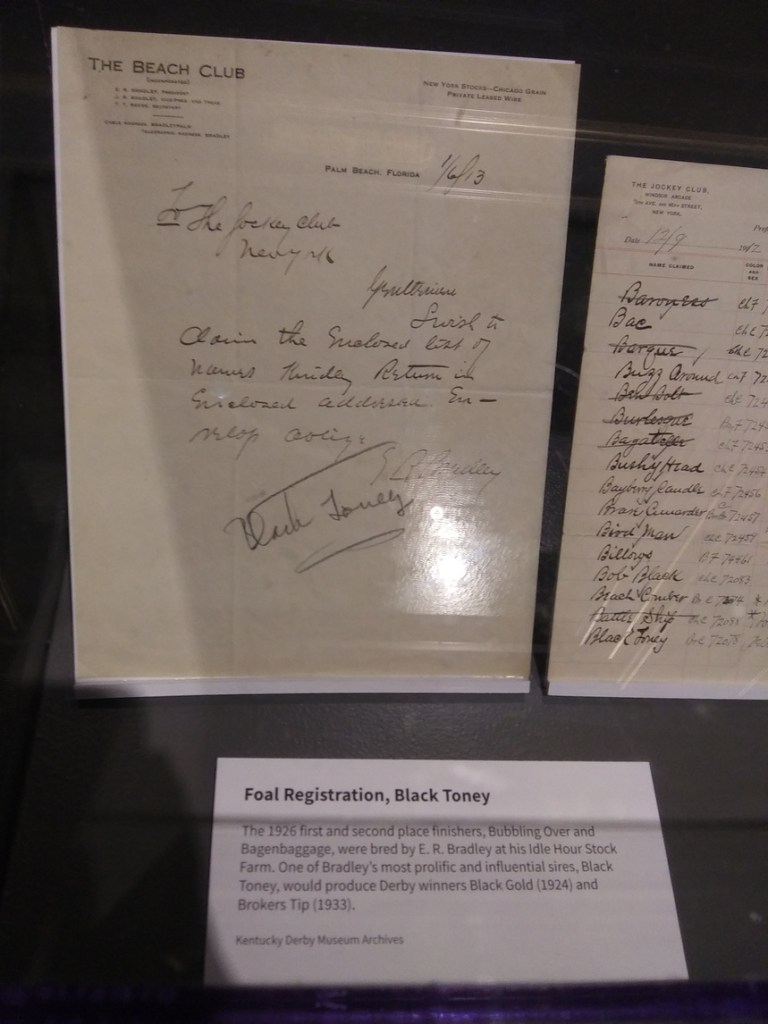
Before leaving the Museum, I paused to see foal registrations for Black Toney and Regret, fascinating to one who loves pedigrees and the history of horses who left their marks on the annals of the Turf. That was where, after the breedings and successful foalings, what they may become all began. With the names they would turn out to have echo through the years.
Regret’s registration record
Black Toney’s registration record
Slight digression, so on to the races!
It was good to get back to the track. (This sentiment was echoed on the Churchill program for the spring meet, as the cover said, “The Track Is Back!”) I’ve been careful even after vaccination about resuming activities around large groups of people, and any of those I have been part of involved being at racing, so it still feels amazing to get to do this again. I never took it for granted before, but definitely time away from even a favorite activity can give it extra resonance when resumed.
Early on in the day, I saw Pat Day near the paddock, wearing a suit. The synchronicity of that struck me as just a short distance away was the statue of him and I had not seen him attending a race day there before.
I witnessed Gunite, the first starter for his sire Gun Runner, break his maiden in his third start. Gun Runner. Gun Runner’s progeny clearly impressed at the sales with an average sales price of $267,750, which made him the leading-first crop sire at two major sales, and have continued to live to up to that impression so far, as he is currently the leading freshman sire by earnings.
The stakes races began with the Fleur de Lis, with Letruska making a start three weeks after her Odgen Phipps victory at Belmont Park. On-site handicappers discussed her chances of continuing her winning ways in that quick turnaround, expressing doubt as she was conceding weight to each of her opponents in the Fleur de Lis, and wondering if it had been too soon since her last race, opining that the “Win and You’re In” status of the race was too compelling to her connections to pass up. My thought was she clearly had been the best on the day in the Odgen Phipps, and probably on a lot of other days. Not being that familiar with the mare or her connections, it was mere speculation on my part, but at the same time seeing that Letruska seems like a star ascending steadily in the distaff ranks, I’d have to surmise her connections were following a path the horse indicated she was able to take and wouldn’t run her back in three weeks if she wasn’t ready. At the wire, Letruska further burnished her status as she was 5 3/4 lengths ahead of the rest of the field. In the winners’ circle, trainer Fausto Guiterrez indicated she may at some point run against colts and thoughts of being in the running for Horse of the Year were not far behind.
A few races later, in the War Chant Stakes, the 3-year-old colt Next by Not This Time, gave me an impression of a little rocket as he surged to victory.
The race day for me concluded with the Stephen Foster, though there was one race to go on the card afterwards. Maxfield further proved his class as he won by 3 1/4 lengths. I had heard of him of course, but had not realized until this race what a near-perfect record he has, victorious in all but one start.
At some point during the race day, I heard a patron near me comment to the people he was attending with about which Kentucky track would race next and speculate that it would be Keeneland “in a week or so.” That stuck in my mind a bit as I know the sequence of Kentucky tracks and their race meets pretty well and it was not Keeneland’s turn, and a while after I wondered if he had been thinking of last year when they did have a July meet. Fortunately, so far the race calendar has been in its normal order and attendance possible too.
Speaking of Keeneland, this year’s October meet will mark the track’s 85th anniversary and they mentioned that soon they will announce protocols for spectators. With several tracks allowing attendance at full capacity, time will tell if they will follow suit. If not, I’ll certainly join the throngs trying to get tickets in advance as was required for the April meet. Looking forward to getting back there either way, likely to be the next time I get to the track.
Going the furthest I’ve gone from home since the pandemic began, walking the streets of New York once more, was inspired by the chance to go to the Belmont and made possible by the work of many who went into making COVID-19 vaccines available. And yet, the roots that racing has grown into the fabric of my being that made it almost a mission to go were sown long ago.
I first saw Belmont Park in 2002, when the popular Evening Attire was still in the early stages of a career that spanned much longer than even most geldings’ careers do, and he won the Jockey Club Gold Cup. My memories of that visit are vague as it was not primarily why I went to New York, but I am glad I took the time to go and see him. What I mainly remember about that day is standing by the winner’s circle after he won. My luggage got lost on the way back home, so I have no photos from then but certainly the gray horse left an indelible image and I followed him throughout the rest of his career.
Returning to Belmont Park in 2019 felt like attending for the first time. It was about a week before the Belmont Stakes would be run, and my plane touched down in the evening in pouring rain. I had been on a plane for hours, after nearly two weeks in England and Ireland (mostly Ireland). I didn’t have the leeway to extend my time off work long enough to catch the Belmont Stakes but it was on my mind. Yet I was glad to see the track again, and enjoyed the beautiful architecture and nods to racing history throughout the facility. It also spurred the goal to attend the Belmont Stakes as soon as possible, the only Triple Crown race I had not attended.
I purchased a ticket sometime in the topsy-turvy year of 2020, so topsy-turvy I couldn’t even remember when I made the first of two payments on the ticket and when I got the notification the second payment was due, wasn’t sure attendance would be possible.
Less than two months ago, NYRA announced attendance would be possible and previously purchased tickets would have seat locations moved to allow for social distancing. That gave me a better seat location without a change of price. The trip was a whirlwind one, with the day of the Belmont being my only full day in New York. When I arrived, I found my seat was directly across from the wire.
Belmont is such a unique track, with its circumference and configuration, that I recalled from my visit two years ago that sometimes I had not even been sure where a race was starting. I suppose it makes sense, then, that a track that large would still have discoveries to yield on only a third visit, particularly with the first one leaving only vague impressions (and that is by no means due to the experience I had, but probably due to a lot of memories made in a short time on that trip). This time it was the revelation that Belmont has two turf courses. I may have heard that or seen it over the years watching races from there on TV, but sometimes only direct observation makes a fact truly register. And it really was a moment of, “Hey, there’s two turf courses!” They don’t do anything in half-measures there!
The first race of the day I caught was thrilling from the start, as the horses burst from the gate right in front of the grandstand (and my section) and it got my adrenaline going. I love that feeling, when the thrill of racing transmits itself to the crowd. It was good to be back for a big race day, my first since the Blue Grass Stakes a few months ago.
A little more than 11,000 spectators attended the day’s racing.
Unfortunately, Swiss Skydiver had to be scratched from the Odgen Phipps, which had been tabbed as a race that may have rivaled the Belmont. She had a fever after shipping, which trainer Kenny McPeek said was probably due to coming by van instead of plane, which had not been an option. The good news is, she shook it off by afternoon. I had looked forward to seeing her for the first time, given that every racehorse of merit was one whose races I had to miss in person last year, like many, but the main thing was doing what’s right for her. Letruska ended up winning the Odgen Phipps. Given that she had a slight edge over Monomoy Girl earlier in the spring, it raised the thought of her career being on an upward trajectory.
I did enjoy the day immensely, but one legitimate complaint has to be noted. Given that this was the first Belmont where fans got to return since the pandemic, and also personally that I had never been before as others may not have, consideration of the experience of paying patrons should have been paramount among everyone on the track in a working role. As mentioned, the first race I saw that day saw the field break from the gate right in front of my section. No one obstructed the view.
I’ve been to a multitude of races and many tracks over the years. I have never once until Belmont day seen a starting gate crew block patrons’ view. I’ve seen them watch a race after the field broke, but they crouched down by the rail. They didn’t stand directly in front of patrons. I have no issue with them wanting to watch the race. But when a seat is right at the start and then later the finish of the race, it is a slight disappointment that people there in a working capacity wouldn’t even consider they are hindering the view and thus part of the experience we paid to have.
That aside, it was an exciting race. I was amazed Hot Rod Charlie was as tenacious as he was in never quite giving up, particularly after having the lead as long as he did, and it seems likely if Essential Quality was not as good a horse as he is, Hot Rod Charlie had every chance to prevail at the wire.
I moved over by the winner’s circle to watch Essential Quality receive his blanket of carnations and the acclaim for his victory; one thing made easily possible by a small crowd to do at the last minute. It gave me a momentary flashback, even, of standing at that winner’s circle the first time I ever came to that track and watching another gray horse after winning a stakes race. Later, I discovered I was in a few professional photographers’ photographs of the ceremony. That had not been on my mind at the time – I just wanted to get my own photos – but it was a happy discovery later as it had been my first time at the Belmont. My favorite capture that I happened to be in the background of was when Luis Saez threw some petals from the carnations skyward, for how celebratory it was.
During the course of the day, there was a large contingent who was greatly enthused about Hot Rod Charlie, and several similar moments where it struck me how happy people must be to get back to the track on days like these. I know that. Many of us did what we could to help curtail COVID-19 spread in the pre-vaccine days, but it could take a mental toll over a long period of time. And things like this, for people who feel racing is intrinsically part of them, no doubt felt an extra level of enthusiasm for the chance to come back and be there in person. I know I did, especially as it was my first major excursion since going to the Santa Anita Breeders’ Cup in 2019.
En route to Silver Springs, the training center affiliated with Spendthrift Farm that adjoins the property, I passed the 30 by 30 foot mural painted on the side of a building in downtown Lexington honoring Man o’ War. I was there the day its grand unveiling was held several years ago, but don’t often pass by it. Happening to glance up just in time to see it, the artistry and scale of it was every bit as awe-inspiring as it was the first time I saw it. Artist Agustin Zarate depicted a pivotal moment in the horse’s race career, his victory in the 1920 Belmont Stakes. In the painting, while the effect the champion had on the people around his is evident, Man o’ War appears so collected and assured that all his glory seems to be singular, emanating from himself as much as it was reflected on or to the people around him.
It was a fitting glimpse at this time, as we approach another Belmont Stakes, and also as I was on my way to a stallion farm and to see young horses in training. While it is unlikely a horse of Man o’ War’s caliber will be among the young horses, naturally the promise inherent in generations of their lineage is evident and hope is ever-present among untried horses. Subsequently, the stallions in the barn have every chance to leave their own marks upon the breed or already have, in the case of Into Mischief particularly. Malibu Moon would have been ranked right with the latter sire as one in the barn who had already left his mark, but had recently passed.
Arriving at Silver Springs, I joined a group for My Racehorse’s event to showcase Authentic to microshare holders who had their names drawn in the lottery to see him, and which would conclude at Silver Springs to view several of the 2-year-olds on offer by MyRacehorse, or who had been on offer before all shares sold.
I had seen Authentic in retirement (and laid eyes on him for the first time outside of photos or television coverage) about two weeks ago. That tour was a bit less hectic, as it did not coincide with two tour groups attempting to visit at the same time and the afternoon breeding session rapidly approaching, besides, with several trailers pulled up and a mare being unloaded by the time we left to go back to Silver Springs. This is not a judgment of My Racehorse or Spendthrift, at all. It is merely a comparison. I am glad they host guests during the breeding season, for even as it is now winding down, it is still a busy time, and I am also glad My Racehorse is able to host events again for microshare holders.
While the visit was a little more hectic with all going on at the time, being there with My Racehorse meant Authentic was led out specifically for our group of 7 to view, and we each got photos with him outside. The other tour group present also lined up for photos, and as I had been taking photos of him instead of jumping in for my turn (although, funny enough, I had not actually been taking photos as I had been a little late for the tour and forgot to put my memory card in my camera right away), I had not noticed the long line growing. So when I mentioned that I wanted a photo to one of our concierges from My Racehorse but wasn’t sure where I’d be in the line, she told me our group took precedence over theirs and I could jump in.
Authentic was a bit feisty; he may now fully expect being led out of his stall but not to his paddock, especially when being close to the breeding shed as he was, meant an imminent breeding session. He was well-behaved, but also acted as a young stallion would, tossing his head a little. But he walked with a fluid elegance and posed magnificently.
Returning to Silver Springs, we saw several fillies that will soon be offered through My Racehorse, and then went to several other barns to see some 2-year-old colts. One of them, by Dialed In out of Wonder Upon a Star, is one that I had been quite impressed by in photos from the auction where he was sold, and also in the assessment Jeffrey Bloom, who picked him out at the sale, gave in a video. I enjoyed getting to see him up close at the training center, where he had just begun galloping. He has a nearly black coat and is dappled. I look forward to seeing where the trajectory of his career goes. Also, there will be a naming contest for him and I have been thinking of names related to stars to honor his dam. It is fun to think of names and be creative with that. I had several I liked but all had been used recently or were permanently unavailable. But after the visit a name for him came to me I like pretty well. I would have preferred to submit Quasar for him, which I had settled on, but it had been submitted and approved too recently for another horse. But sometimes this leads down a path of thinking out of the box and being more creative to come up with a name, and I enjoy the process.
I hope to come back for the MyRacehorse tour at least one more time (and this time not forget to have my memory card ready to go!) for photos of Authentic outside of the barn, but also would someday like to bring some family to see him, and that would mean the Horse Country tour would be more suited. My Racehorse limits numbers to one guest per shareholder, to give options to as many different shareholders to see him as possible. While family visits have been off-limits due to the pandemic if they live in another state as mine do, it is natural to think of wanting to see them again and share more experiences.
But today was about the experience My Racehorse provides, and also marks beginning to see the pandemic loosen its grip a little, as this tour would not otherwise have happened. And I am grateful for that, for the first event with Authentic through the entity that made shares of him be within reach and gave me the brightest moments of the rough times of the pandemic last year.
As more people begin to be vaccinated for COVID-19, farms around central Kentucky that are part of Horse Country have begun to welcome visitors again after a substantial hiatus, and Spendthrift was one I had been most eager to get to as a microshare holder in Authentic who never got to see him during his race days due to the pandemic.
My Racehorse actually held a lottery recently for lucky share holders to see him, also, but I wasn’t chosen this time. However, with Horse Country tours also an option, I got to select the day I went and chose my birthday. I also brought peppermints for Authentic, as he had been such a bright spot with his victories in a challenging 2020, and I wanted him to have something he liked for the groom to give him later.
Several other microshare holders were on the tour, and we got a brief glimpse of Authentic looking out of the stall before moving on to the breeding shed, to get an overview of Spendthrift history and graded stakes winners commemorated in plaques around the walls. It was nice to pause and reflect on the history of the farm, and be among the horses and the beautifully landscaped setting.
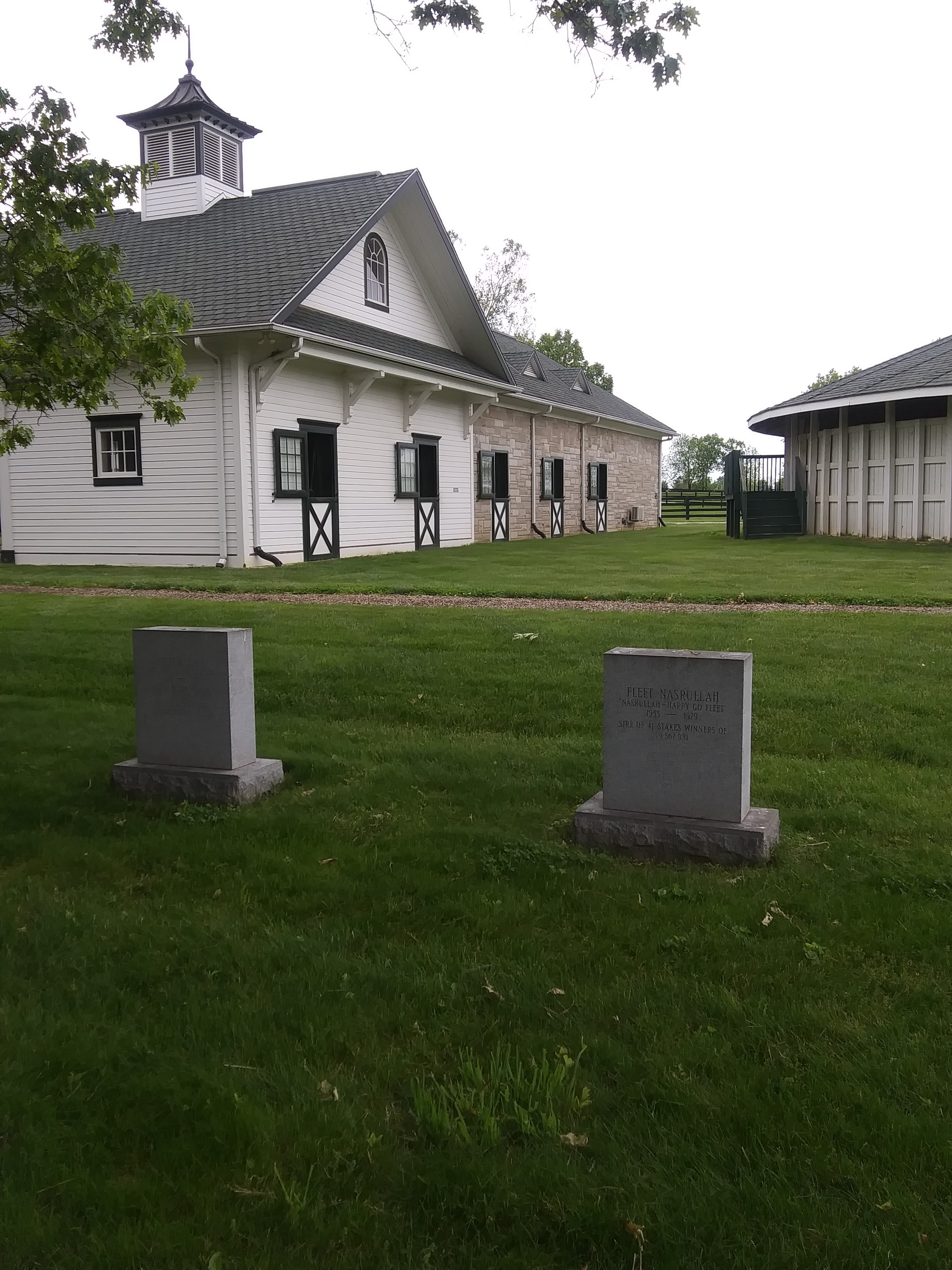
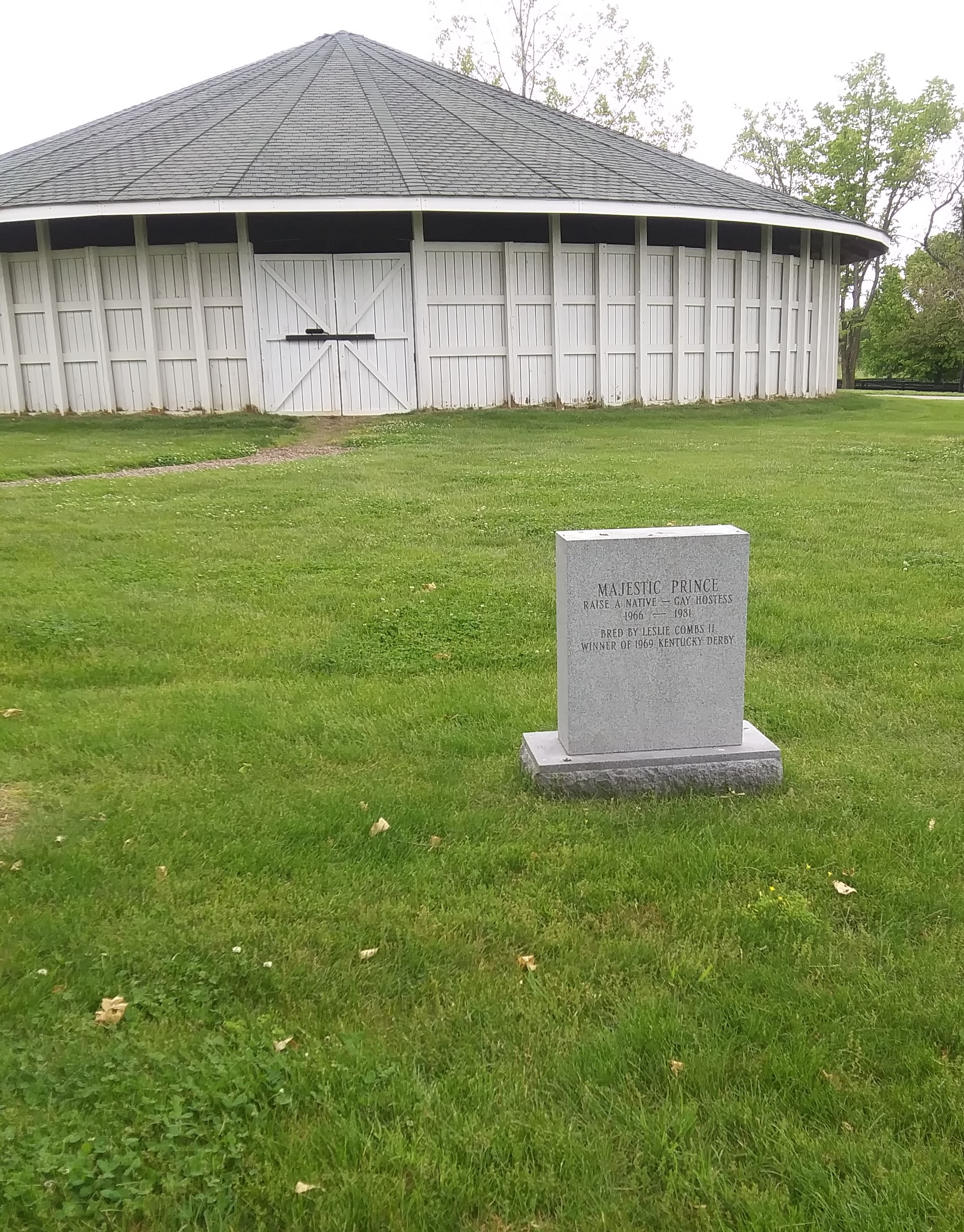
While standing in the aisle near holding stalls, a teaser was brought in and vans carrying mares for afternoon breeding sessions arrived. Brody’s Cause was the first stallion to go into the breeding shed for the afternoon, and we wandered the stalls of the U-shaped barns to get a look at the inhabitants, and viewed the horse cemetery before moving on to the barn where Into Mischief, Malibu Moon, Authentic, and several other stallions reside.
Idyllic setting for the horse cemetery
Majestic Prince’s gravesite
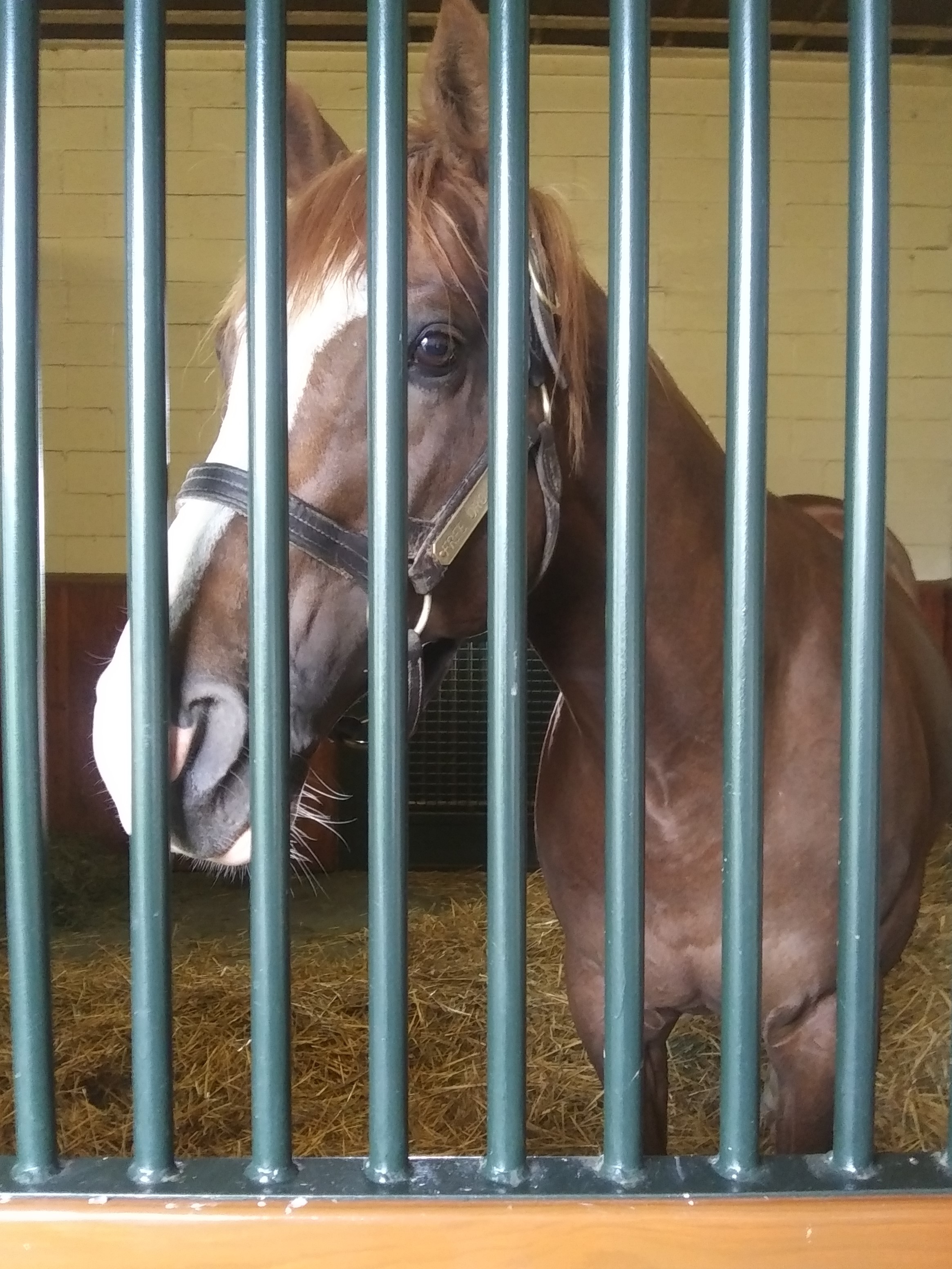
Free Drop Billy
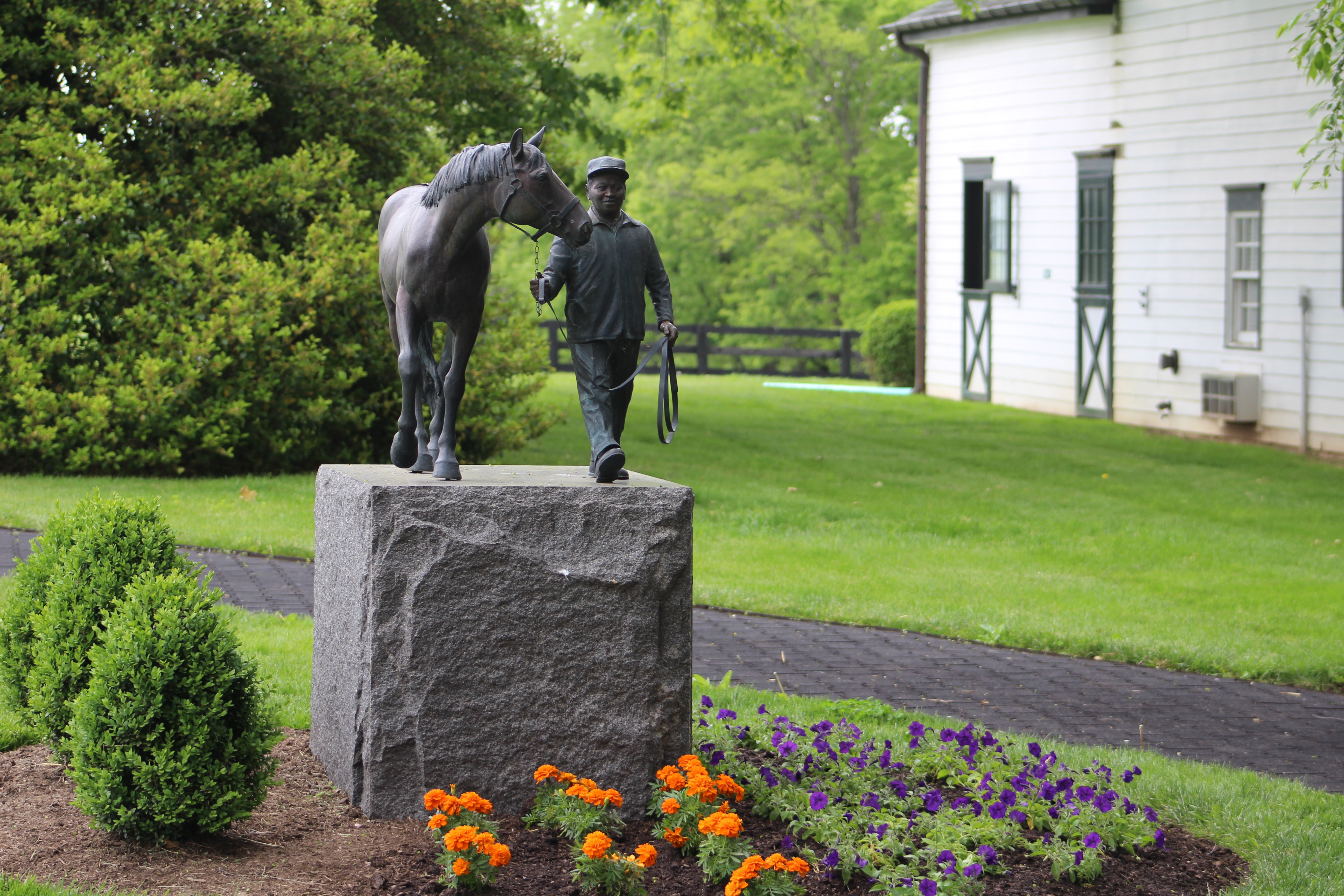
Statue of Nashua and groom Clem Brooks, with flowers in the Spendthrift silks colors planted at the base
Authentic was getting bathed when we walked in, and I was impressed by his physique. While he’s nearly an entire breeding season removed from his racing days, his athleticism was still evident in his muscular build.
Our tour guide spoke of Lord Nelson, and his fight with laminitis that delayed the start of his stud career, and she said he basically owed his life to Barbaro and the advances made in the treatment of laminitis during the latter’s own case of it. I reflected on that for a moment. I still believe Barbaro was a sublime talent who could have won the Triple Crown with a different set of circumstances, and it did hit me hard after his long road to what seemed like it would be recovery at several points for him to succumb after all. But then, he left an enduring legacy for horses like Lord Nelson, and maybe if that was to be what he gave to racing post-career, perhaps that is more meaningful than a Triple Crown win, as sad as it is the advances made did not save him. But I know they tried all they could, so I am also glad the statue at Churchill Downs is dedicated to his racing glory and all the promise he showed.
As the tour began to wind down, we each had an opportunity to get time with Authentic one-on-one when he was back in his stall, and get photos with him as well. It meant a lot to me to have those photos, and spend some of my birthday with him.



 Called To The Post