Called To The Post

~ Covering racing, horse photos, and my travels from time to time (all content copyright reserved)

Called To The Post

Tag Archives: American Pharoah

The Inspiration of “Pharoah”

17 Friday Mar 2017

Posted by Sarah Troxell in Uncategorized

≈ Leave a comment

Tags

American Pharoah

I recently attended a great program at my local library consisting of a BBC-funded film, “To Defuse a Bomb,” a documentary about Project Children, an organization that brought children from Northern Ireland to America during “The Troubles” to give them a respite and a safe haven for a summer. Project Children also brought together Protestant and Catholic children, often with the same host family, which was not possible when they were back home since they didn’t go to the same schools or live in the same neighborhoods.

As they said in the film, bringing together the children of different faiths planted a seed – when their families said negative things about the opposite religion from the one they practiced, to those who had been part of Project Children in America, they had a different view of the Protestant and Catholic divide. It meant to some of the Catholic children in Ireland, a Protestant was not a nameless, faceless “other” that it was easy to see as an enemy, and vice versa. It was a simple formula, and it didn’t always overcome the strife and unrest when those children went back to Northern Ireland, but it definitely made a difference.

One of the children interviewed for the film reiterated that when he said he didn’t picture a person who he didn’t know and who was too different from him to ever find common ground with. He envisioned the person he had known and lived with for six weeks in America. They fought at first on the plane ride over to America, and they were suspicious of one another when they ended up being assigned to the same family overseas. Yet they managed to put that behind them eventually, even as they knew when they went back home there was no way they could associate with each other. Yet neither forgot that the “other” was a boy much like himself, who liked swimming and baseball.

It takes more than that to overcome decades of strife among people split by division, but its successes were great. It expanded beyond the few cities where it began in upstate New York, reaching Washington D.C. and host families there. The two children who fought on the plane on the way to America and ended up with the same host family, two children that were some of the first participants in Project Children, ended up being lifelong friends who were best men in each other’s weddings and still visit their American host family frequently. They went back to stay with that family for years while growing up, and their host family had photo albums full of their childhood pictures. They became as much a family as their blood family in Ireland was.

It was also mentioned in the documentary that the opportunity for America to help intervene in a positive way to further help spread peace was started when Project Children expanded to D.C. and one of its organizers, a New York City Police Department bomb squad expert, was invited to the Clinton White House to be honored for his work with the bomb squad. After receiving his award, he was returned to speak to Clinton about the work with Project Children and the need to help the young people in Northern Ireland have a chance to escape the strife where they internalized all the war and animosity as normal, and played games that consisted of conflict and throwing rocks at soldiers and tanks in their neighborhoods.

Clinton paid a visit to Northern Ireland in 1995, helping to foster peace talks between the opposing sides. It was the beginning of the turning point in all the strife there.

The program concluded with live music by the band Gypsy’s Wish, comprised of one of the young men – Declan Cheara (McKerr) – who participated in Project Children while he was growing up, and his friend Andy Toman.

Like the young boys who were extensively interviewed in the documentary, McKerr was also introduced by explaining what a difference Project Children had made in his life. He and Toman had come over from Ireland just to participate in the program held that evening and the following one, and while visiting Kentucky, they also did some sightseeing.

They had visited Ashford earlier in the day and seen American Pharoah. It is well-known “Pharoah” is one of those horses that makes everyone stop and notice. I saw this first when he floated so effortlessly across the training track at Keeneland one October morning before the 2015 Breeders’ Cup, and the ripple of excitement his appearance generated was almost palpable. The star power evident in the very fiber of his being was harder to define, to quantify or explain, but that is fitting for such a rare individual as a Triple Crown winner. It was that star power, that wellspring of talent and the effortless motion of his gallop, that made everyone stop and watch and that made the excitement ripple through us all.

A similar measure of this palpable excitement – while we no longer see him in race training or actual races – has not abated at all among his visitors at Ashford. It strikes even the most illustrious breeders or owners, those who have doubtless seen many top racehorses to also be nearly starstruck and awed by what an amazing physical specimen Pharoah is. That too is fitting. I would hope a Triple Crown winner, especially after all these years of waiting, would still be regarded as exceptional. This possibly sounds like deification yet I guarantee anyone who has seen him in person understands the deep awe at being in his presence. It is nearly unavoidable.

It was interesting to hear McKerr’s impression about his visit with American Pharoah. I don’t know if he liked racing or followed the sport in Ireland, but knowing of him only in the context of a musician, it was intriguing to hear that Pharoah inspired him as well.

That is the gift of a top racehorse, and one Pharoah has achieved in spades.

McKerr said of his visit with the champion that American Pharoah looked like mahogany, a description that I loved. He also noticed how incredibly muscled he is. It drew me back to my first time standing next to Pharoah, and it was those things about his near-impeccable physique that awed me too.

Pharoah, in fact, had inspired McKerr to the point that he included a song about horses in their set that night. I guarantee, like any lucky enough to be in Pharoah’s presence in retirement or in his racing days, that McKerr will always remember too how it felt to see him in person.

You see, the difference coming to America as part of Project Children made to McKerr’s life – besides giving him a respite from the strife – was that he was drawn to play guitar, influenced by Jimi Hendrix and Carlos Santana. Much like Pharoah was in a class of his own when he ran, so was McKerr when he played guitar. He struck me as a near virtuoso, and getting to experience his incredible talent in person inspired me just as much as Pharoah’s did.

I once had thoughts of learning guitar, but put the lessons aside once I realized it would be difficult to master while trying to finish my degree and work full time, but this program made me want to pick it up once more.

Gypsy’s Wish, inspired by their visit with Pharoah, added the song “Ride On” to their setlist. I wanted to know more and looked up its lyrics afterwards.

According to the website songfacts.com, ” ‘Ride On’ was written by one of Ireland’s most famous songwriters….Jimmy MacCarthy….MacCarthy explained on Radio Eireann in February 2010 that this song’s lyrics hark back to his days as an apprentice jockey. When they first began training for races the younger horses would gallop behind the older horses. But as the younger horses developed, they needed the horses in front to go faster, so the jockeys would shout out ‘ride on.’ “

I think anyone who’s been at the track or watched horses in training has seen that moment when a horse exceeds what the competition can do if he or she has a future as a good or great runner. For some, that moment of top potential is evident early on, and that is how it was with Pharoah.

The song lyrics itself, while clearly directed to a person instead of a horse, were also reminiscent of the greats like Pharoah:

Sure you ride the finest horse I’ve ever seen,

Standing 16 one or two, with eyes wild and green

You ride the horse so well, hands light to the touch

I could never go with you no matter how I wanted to

Ride on, see you,

I could never go with you no matter how I wanted to

Ride on, see you, I could never go with you no matter how I wanted to

It was a fitting song to describe Pharoah and what he meant to them, and an unexpected intersection of racing and music – two of my great loves – in the same evening, and I appreciate the library for hosting it and the band for coming from Ireland to visit and share their talent.

https://youtu.be/RT5ILK5-DXU

Consulted source: http://www.songfacts.com/detail.php?id=18923
Pharoah Comes to Saratoga

02 Wednesday Sep 2015

Posted by Sarah Troxell in Uncategorized

≈ Leave a comment

Tags

American Pharoah, Saratoga, Travers

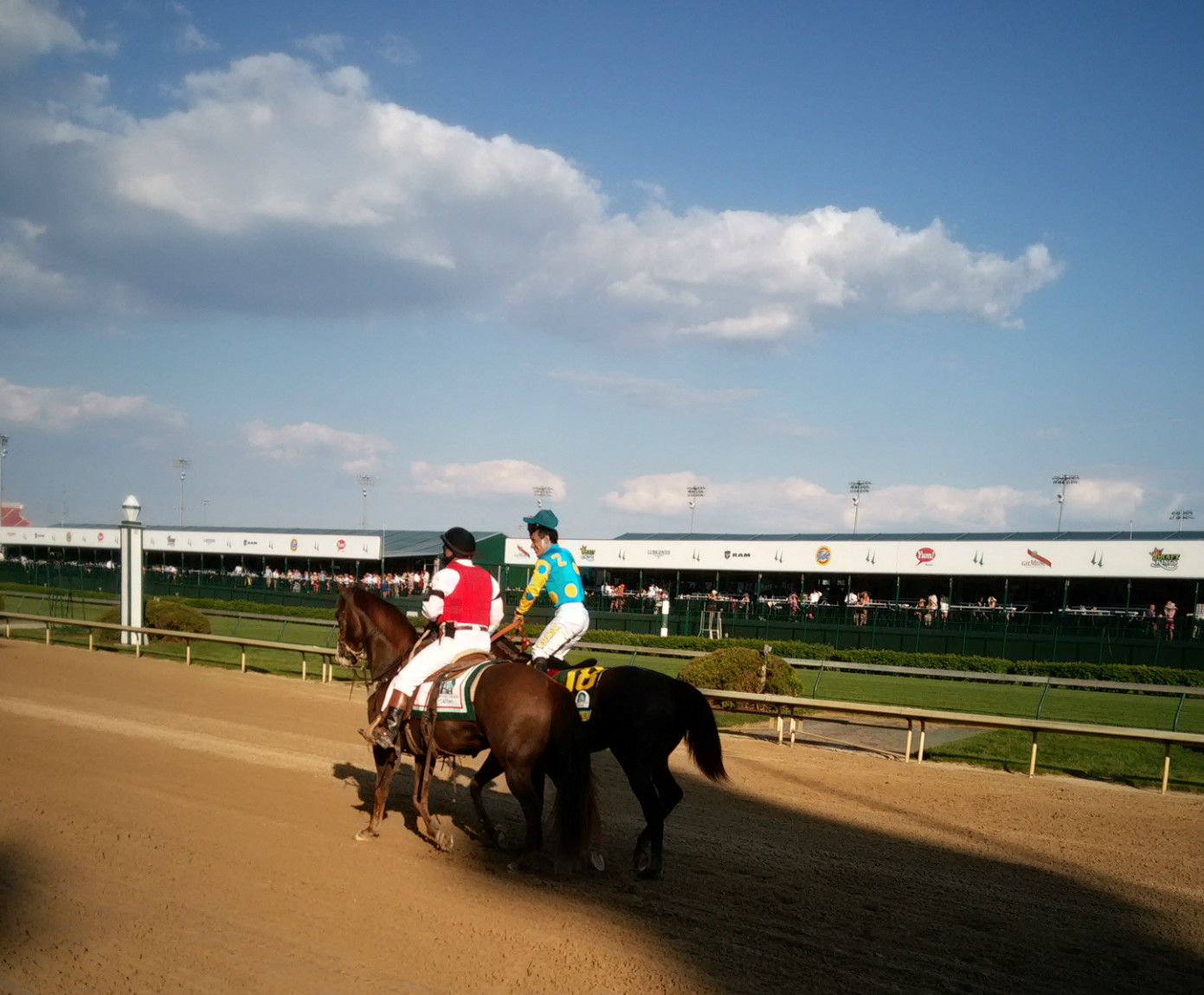
American Pharoah arrived shortly before the August 29th Travers Stakes, a much hoped-for appearance at the grand Saratoga course that boosted one of its signature races to a purse of $1.6 million.

Attendance for the day was capped, as it had been at the Belmont Stakes and at the Haskell. The desire to see the sport’s first Triple Crown winner in nearly four decades remains strong, and who wouldn’t want to say they once saw Pharoah in the flesh, in a race? It’s a story to tell the grandkids, or an occasion to share with the grandkids, if they are already here.

As usual, Pharoah didn’t look like he’d lost much ground, and it was reported that his weight has held fairly constant, a good indication of a horse’s well-being. He followed the usual routine of training in California and shipping to the track where he’d race a few days before running, and as the Zayats were interviewed in the paddock amidst an enormous amount of people waiting to see their star, their pride in him was evident. I commend Mr. Zayat for being so sporting, and taking his horse so many places people wanted to see him. It does loom, as Bob Baffert mentioned on the telecast, that he will be retiring soon, so it is wonderful they are providing the opportunity for as many people to watch him run as possible.

I was out of town visiting a friend when he ran, and watched the race over twenty-four hours after it occurred. I watched him sit back effortlessly, and he appeared to just be waiting for the cue from Espinoza to go, to run freely, as I had seen so often. When he got it, it didn’t take long for Frosted to match him stride for stride, but he still looked like he could put him away and he did begin to pull away from his opponent. Normally, he would have been gone in a blink, but he was having to really dig down and fight this time.

Perhaps that, and all the traveling back and forth was too much for even Pharoah this time. As we know, Keen Ice just managed to run him down and that left Pharoah to hold on for a gallant second place finish.

I read afterward that Mr. Zayat spoke of possibly retiring him now. I know it is a different world from when most of the previous Triple Crown winners raced. Of course, Secretariat was famously syndicated for millions, but Citation raced well past his 3-year-old year with the goal of earning a million dollars. Times have just changed in the racing industry, and a good or great colt is often ushered into the breeding shed quickly. Naturally, the risk of injury and the cost of insuring a great horse is a consideration. But I still think Zayat did the right thing sending Pharoah to the Travers.

It is moments like those, even when the horse doesn’t win, that can show what they are made of just as much as a victory can. There was no shame when Zenyatta lost to Blame in the Breeders’ Cup Classic the way she did. She never quit trying, and Pharoah never quit trying in the Travers. In fact, I believe he dug so deep when eye-to-eye with Frosted because he is all heart and every bit a champion. A lesser horse would not have kept digging in.

I know there must have been disappointment at Saratoga from those who wanted to see him win, and I know there must have been disappointment among his connections, as indicated by Zayat saying he might just retire him now. I hope he doesn’t regret for one moment his sporting gesture to let Pharoah race at Saratoga. It still showed those present the heart of a champion, and what you’d hope to see in a racehorse. Even in defeat, there can be a story worth telling the grandchildren – about perseverance and determination.

And if he has come out of the Travers well, I do hope to see him in the Breeders’ Cup Classic. It might be a tall order for a three-year-old who travels constantly and has already won a Triple Crown. But we know Pharoah will try and I think he deserves the chance, one last opportunity to show what he can do before he takes up residence at Ashford. Not that he or the Zayats owe racing anything else, of course; I’ll always cherish that memory of what it felt like to see him and Espinoza parade before the grandstand to the cheers of the Derby crowd, and how it felt when he won the Crown. But to give him one more chance to meet his adoring public would be another grand sporting gesture that those in attendance wouldn’t forget – the day they saw American Pharoah in all his majesty, close enough to touch.

Wherever he goes from here, though, he has built a substantial legacy and given people a treasure trove of memories. And that lingers longer than any single afternoon where he was passed by a single rival.

Triple Crown glory, at last!

07 Sunday Jun 2015

Posted by Sarah Troxell in Uncategorized

≈ Leave a comment

Tags

American Pharoah, Triple Crown

June 6th, 2015. Belmont Stakes day. There was yet another chance for a Triple Crown to become reality, as American Pharoah attempted to turn Derby glory and Preakness success into racing’s most elusive prize. A list of the names of horses who had prevailed in the first two legs and come up short in the third, the most taxing of all, revealed again that a very good horse is just not enough. He has to be great, in a class of his own. And that is just how American Pharoah was being described in the weeks, days, and especially when it got down to just hours until he contested the Belmont.

I’ve heard horses who were just one race away from being potential Triple Crown winners described as definitely being worthy and having what it takes to pull off that accomplishment. I understood, to those who were rooting for a Triple Crown winner, that it is hard not to seek out the reasons why any particular horse with a chance just might be the one to do it. I understood because I have walked that path too, since Silver Charm had his shot in 1997 and for quite a few horses after him. The racing-obsessed part of me wanted to see a Triple Crown winner in my lifetime. By the time Silver Charm had a shot, it had been 19 years since a horse won it, and I was 18. Too young to have been alive when Affirmed and his young jockey won it. So it went, through Real Quiet, War Emblem, Charismatic…. on to Big Brown in 2008. I now believe Barbaro had the most likely combination of talent and ability to pull it off, out of all the horses that made their run through the three races from 1997 to 2014. But as is well-known, it was not his path to see his try at glory go beyond a few strides into the Preakness. Everything they said about him and that I saw myself – his floating running action that made everything look so effortless, most notably – really made me think it was his to lose. It is a shame he was injured, for his own sake naturally, but also because all questions about the capability of the undefeated colt who looked like he literally soared when he ran were left unanswered.

Then Big Brown had a shot in 2008. For reasons that have been forgotten, I really thought he would be the one to pull it off. Disillusion followed when he was pulled up in the Belmont, and never really given a chance to try. And that is when I began to quit expecting a Triple Crown winner. This is not meant to sound pessimistic. It was just pragmatic, realistic. I didn’t think it was an impossible feat. The right horse could probably still pull it off. But it was so much easier for a horse to win two legs and not the third, and there didn’t have to be a Triple Crown on the line to witness historic achievements in racing. Rachel Alexandra and Zenyatta proved that.

Still, it was a good story to see California Chrome and Victor Espinoza have their moment in the spotlight last year. It was even more incredible to see Espinoza win back-to-back Kentucky Derbies, after he captured this year’s edition with American Pharoah. It brought back memories of the first time I witnessed a Triple Crown race at a track, when Espinoza and War Emblem captured the Preakness, and I cheered them on with a large group of people that had gathered to watch on the big screen in the Churchill Downs paddock. That memory stretches back to my earliest days in Kentucky, when I was just a visitor finally making my way to a bit of a personal mecca, the horse farms of the Bluegrass region and of course the home of the Kentucky Derby. I liked Espinoza’s seemingly sunny nature then and I liked to see it again as he added more Derby wins to his resume, handfuls of years later.

But most of all, I liked American Pharoah on a deep level, in a way I couldn’t shake. That too stretched back to earlier memory, this one rooted in the initial foray into an interest in racing that bloomed into a passion that never left. It was when Unbridled won his Kentucky Derby and trainer Carl Genter memorably provided a stretch call for owner Frances Genter. That now lives in Derby lore, and maybe it captivated me because it really showed how amazing it can be to someone to win that race. And maybe too I just liked Unbridled’s name, and the freedom it represented to follow your own path or your dreams.

Whatever it was, I followed that early interest in Unbridled – as said in a previous post – through the generations, until his great-grandson American Pharoah had his shot to win the Derby, proving himself to be the best of a class of deeply talented three-year-olds. They are no doubt still good horses, and some may still be close to greatness. But at every step of his Triple Crown run, from Louisville to Baltimore to New York, American Pharoah had a way of making them mere footnotes to his own legacy. I sensed that even when he entered the paddock for the Derby. There was just something about him that did put him in another class. I will never forget thinking, “Finally!” when he won the Derby, thinking how at last an Unbridled descendant wore the blanket of roses on the first Saturday in May. I will also never forget all the jubilation I felt when Espinoza brought him past my section of the grandstand and it was such an exciting moment to cheer on the newest Derby winner that it felt like my Derby win too, in a sense.

Victor Espinoza tips his cap to the roar of the record Derby crowd, cheering for him and American Pharoah

Victor Espinoza tips his cap to the roar of the record Derby crowd, cheering for him and American Pharoah; my favorite post-Derby memory from this year

Then of course it was on to Baltimore. I had to work on Preakness day, which fell on my birthday again this year. I didn’t get to see the race until it had already been run, but I had no doubt American Pharoah would win it. About the next step – that elusive Belmont Stakes victory – I wasn’t so sure. He was very good, maybe even great, but I hesitated to get my hopes up too much. If it happened, it would happen. All the previous attempts made me just take a “wait and see” attitude. But beneath all that, I must have felt like he had a real chance. There were several good reasons for this: the impression I gained of him at Churchill Downs, that characteristic that emanated from him even before he won the Derby, of how good he really is; the way he shook off the less-than-ideal track conditions in the Preakness, as Pimlico was hit by a torrential downpour just minutes before the race, and still won it with ears pricked, easily and well within himself. There just almost didn’t seem to be a challenge for this colt whose gallop was described as being like a floating action, almost like he soared when he ran. That to me was reminiscent of the description given to Barbaro’s stride. Between his Preakness and Belmont, when I saw how even the sloppy track couldn’t stop him and the way it looked like nothing had been taken out of him, the way he moved so easily, I think deep down I really began to think it was time for the next name to be written into the list of Triple Crown winners.

When I had a dream a few days before the Belmont that he won it, and that I felt disbelief that it had actually happened and then joy like I felt when he won the Derby, it made me pause. I don’t place any stock in dreams for any kind of capability of telling the future, but I do believe sometimes they tell us something we realize on a subconscious level but don’t let come into our thoughts in our waking hours. I didn’t see that dream as a “prophecy” by any stretch of the imagination, but I did see it as further revealing that American Pharoah probably had what it took more than any horse had since Affirmed won the Triple Crown in 1978.

I read the statistics: Horses that haven’t raced at Belmont traditionally haven’t fared well at the track. American Pharoah had not raced at Belmont. Jockeys have to be familiar with the track. Espinoza had a small number of winners out of total mounts. But then, his total mounts at the track were a small pool too, given he is mostly California-based.

That is one thing about statistics. They represent what the average is, the norm. But all it takes is the right conditions for them to find an anomaly to the data they represent. I considered that. I still wasn’t trying to get my hopes up but under the surface I still couldn’t shake the confidence I had in Pharoah. In this case, all it took for those statistics not to matter was the right horse. If he truly was worthy of winning the Triple Crown, none of that would matter.

What I had realized in all the years of seeing horses fall short was that even if a horse only lost the Belmont by a nose, that was all the distinction necessary between a good horse and a great one. A Triple Crown winner would need no excuses, or for everything to go perfectly. Everything would go perfectly because he would just be great enough to make it go perfectly. That may sound naïve, since they are horses and can have off days and still be great, but I do believe what so many do: The Belmont is considered the Test of the Champion for a reason. Only the best horse will prevail there, after five weeks of travel and different race distances and surfaces.

So I found my way to Keeneland, in between working at a horse farm in the morning and before going to work at a different job that evening. I still wasn’t saying it out loud, that it was going to be all Pharoah at the wire. But I wasn’t ignoring my gut feeling either, borne out of my impression of him personally, even of the dream, and of everyone’s descriptions of how well he was still training and still floating over the ground with that effortless stride. I had considered going to Churchill to see him the weekend before the Belmont, where the interest in him was so strong that the track opened up special training hours for him in response to all the calls from people wanting to see him. I ended up opting for a relaxing day, but I followed the progress of his last two gallops there with interest.

When I pulled into the Keeneland grounds, it felt like a bit of deja vu, back to the day when I went there to bet on Empire Maker to win the Derby. I was in that fervent, “he-just-has-to-do-it” stage then, while I was being a bit more settled about Pharoah. But the same desire was there, to have a win ticket on each horse, almost like putting my money where my mouth is gave my hopes of victory for them more weight.

But in fact, I didn’t feel so over-excited about Pharoah as I almost had about Empire Maker, because it really almost seemed like a logical conclusion he was going to win and that is all there was to it. All these years of not seeing Triple Crown winners made me a bit cautious to say that out loud, but deep down I just knew.

So I got my win ticket with his name on it and a program from Belmont to fit into my racing memorabilia collection. Then I went to work, and finally got to watch the race when the day it was run was nearly concluded. Even though I said I wouldn’t get my hopes up again, even though I wondered how the game plan of going to the lead immediately would impact his chances at the finish, I felt hope surge to a crescendo as I saw he was running so easily and with barely controlled power. He was just asking to be let loose when the time was right. It was extraordinary, after all these years, that a horse had plenty in reserve, that he was just waiting to be asked to run. And his ears were pricked, and he was still running well within himself when Espinoza gave him the signal to go. He took up a two-length lead so smoothly it really did seem he just glided there, and everything fell into place. There was just nothing any horse in the field could do against all that latent talent that lives in American Pharoah. He opened that lead easily to 5 ½ lengths at the wire, and then I knew for sure at last what it takes for a horse to be a Triple Crown winner. It takes the horse that makes it look effortless, because if a horse even fell just a nose short, he was struggling with the task as it was laid out. All it took was the right horse, and here he is at last, the first one I’ve seen in my lifetime. I just knew nothing was going to get to him, and then began my litany of “He’s gonna do it, he’s gonna do it, he’s gonna do it” all the way down the stretch. It was just like the dream I had, with disbelief followed by joy.

There’s still disbelief, not in what Pharoah is capable of, but just that the words “Triple Crown winner” can finally be used again for a new name in the list of those that have accomplished racing’s hardest achievement. Just as I thought when he won the Derby and it went to an Unbridled descendant, “Finally!” The Triple Crown has been won again. It is amazing just to be able to type those words, to see them be true at last.

I saw a USA Today journalist recently wrote that a Triple Crown winner will not “revive a dying sport” mostly finding its fandom among senior citizens and no younger people. She clearly was out of touch with the racing world. I know all across Lexington, this victory was celebrated. My jobs bring me in contact with a lot of the public, and I know this to be true. And of course, Lexington is a cradle of racing. It is a city where people still stop to follow all of racing, not just its biggest days. It is a city where young and old flock to the races, where kids are brought to a Keeneland meet as a spring and fall ritual, one they continue into their teens, twenties and beyond. Maybe that is a statistical deviation, because Keeneland is such a unique track, but I see young kids gather at Louisiana tracks, at Santa Anita, at Churchill… American Pharoah’s history is rooted here, too, with his dam and sire both residing in central Kentucky, with his great-grandsire Unbridled lying at rest at historic Claiborne farm….

I won’t deny the racing industry has lost traction in the entertainment realm since Affirmed won the Crown. It is a different world. But American Pharoah pulled off a feat we may not see again for a long long time. His accomplishment means everything to many people who live and breathe racing, who find their livelihood because of it. And it means a good, lingering memory for its many fans across the globe, of the day Pharoah proved once more what Triple Crown greatness really means. That is an achievement that will endure and long be remembered. And I am so glad I got to be there on the first step of his journey on Derby day. What a glorious run. What a tremendous horse.

Recent Posts

  • D. Wayne Lukas
  • Small Miracles
  • The Meaning of Caldera
  • “For Generations To Come”
  • Preakness Pinnacle

Archives

  • June 2025
  • March 2025
  • February 2025
  • November 2024
  • May 2024
  • April 2024
  • February 2024
  • October 2023
  • August 2023
  • April 2023
  • July 2022
  • June 2022
  • May 2022
  • April 2022
  • March 2022
  • January 2022
  • December 2021
  • November 2021
  • October 2021
  • September 2021
  • August 2021
  • July 2021
  • June 2021
  • May 2021
  • April 2021
  • February 2021
  • November 2020
  • October 2020
  • September 2020
  • August 2020
  • May 2020
  • April 2020
  • January 2020
  • August 2019
  • March 2019
  • February 2019
  • January 2019
  • October 2018
  • August 2018
  • July 2018
  • June 2018
  • May 2018
  • March 2018
  • February 2018
  • January 2018
  • December 2017
  • November 2017
  • June 2017
  • May 2017
  • April 2017
  • March 2017
  • February 2017
  • October 2016
  • August 2016
  • March 2016
  • November 2015
  • October 2015
  • September 2015
  • August 2015
  • June 2015
  • May 2015
  • April 2015
  • March 2015
  • January 2015
  • December 2014
  • October 2014
  • August 2014
  • April 2014
  • March 2014
  • February 2014
  • January 2014
  • December 2013
  • October 2013
  • June 2013
  • May 2013
  • April 2013
  • February 2013
  • January 2013
  • December 2012

Categories

  • Uncategorized

Meta

  • Create account
  • Log in
  • Entries feed
  • Comments feed
  • WordPress.com

Blog at WordPress.com.

  • Subscribe Subscribed
    • Called To The Post
    • Already have a WordPress.com account? Log in now.
    • Called To The Post
    • Subscribe Subscribed
    • Sign up
    • Log in
    • Report this content
    • View site in Reader
    • Manage subscriptions
    • Collapse this bar
 

Loading Comments...