
When I recently purchased an issue of the Thoroughbred Times from April 12, 1997, it felt like stepping into a time capsule of racing at that time.
A little insight into my life at that time:
I was in the last few months of my senior year at high school, and had been taking a journalism course for several semesters. One of the first articles I chose to write about for the school paper was about Cigar. When the edition of the school paper was published that contained that article, a teacher whose classes I had never taken came to the journalism teacher, Mrs. Hartley, and asked her who I am. Through that article, I met another racing enthusiast in Mrs. Hoye. I hadn’t met any others during my residency in Tennessee before that point.
Mrs. Hoye and I would sometimes talk about the journey various Triple Crown race hopefuls took during that spring, and she also graciously photocopied every article she had that the Thoroughbred Times published about Cigar.
When I graduated from high school that year, she and a teacher I did take a class with pooled their resources to gift me my own subscription to the Thoroughbred Times. I also had begun riding horses with Mrs. Hartley, the journalism teacher, since she owned a horse and a pony that was large enough for adults to ride.
Part of this issue of April 12, 1997, was a flashback both to that time in my life and to the racing scene at the time. The top story of the issue has the headline “Free House speaks for himself in the Santa Anita Derby,” with the addendum underneath, “Toffan and McCaffery homebred scores dramatic, emotional win over Silver Charm on the road to Kentucky.”
It was reporting of the thrilling rivalry that unfolded that spring between Free House and Silver Charm, and later Captain Bodgit, which I remember so well. It was exciting to watch. While I had first been drawn to racing in the early ‘90s in my childhood, 1995-1997 were the years my interest was most piqued by it. Reading through the account of the Santa Anita Derby with Free House and Silver Charm pursuing a spot in the Kentucky Derby starting gate, when I saw Hello and Sharp Cat also noted for their part in that Santa Anita Derby, all the names brought back how indelibly the late ‘90s in racing captured my interest. I didn’t know it then, but that very horse-centered time of my life in the late ‘90s was setting the stage for what would ultimately see me relocate to Kentucky to be in the center of many things horse-related.
Near the front of the issue is an advertisement for the stallion Williamstown, by Seattle Slew, who was standing at Payson Stud on Paris Pike in Lexington. Years later, after it had changed ownership and was no longer called Payson, I worked on that farm as an intern. I managed the social media for the farm, taking photos of their mares and foals and general farm scenery to post with captions. I never worked at any of the most well-known farms in the central Kentucky area, but even working at a farm for a time with a lot of the history of racing on its grounds was special. The color schematics of Payson had been left on the barns by the owners who took over, so I did indeed feel a sense of stepping back in time to what had been.
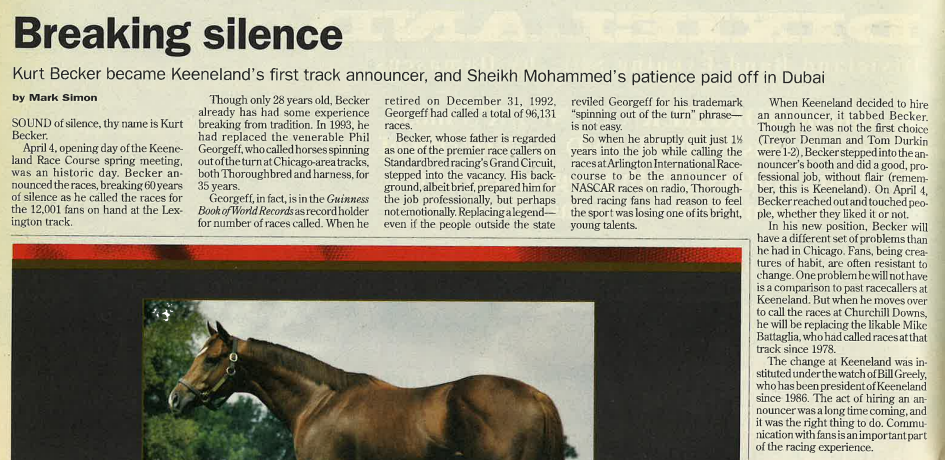
I was also intrigued to read of how racing journalists reported Keeneland adding a track announcer in 1997 for the first time in its history. From today’s perspective, it is hard to fathom a track not having a race announcer, and I had never read how that change was reflected upon at the time it was made. Here is how it was reported by the Thoroughbred Times journalists.

I hope you enjoyed this walk down memory lane of the spring of 1997 in racing.

