Called To The Post

~ Covering racing, horse photos, and my travels from time to time (all content copyright reserved)

Called To The Post

Category Archives: Uncategorized

Cumberland County Fair Racing

25 Saturday Aug 2018

Posted by Sarah Troxell in Uncategorized

≈ Leave a comment


The Cumberland County Fair in Greenup, IL, has a commitment to horse racing stretching in an unbroken streak to the fair’s inception in 1888. For anyone who attends now, or envisions horse racing in a fair setting, it is intriguing to think of what it may have been like to attend their first day of racing and how it has evolved over the years. One could imagine it being a fun event for people whose way of life revolved around farming, to have a little fun and socialize, all while cheering on favorite horses.

The day’s card of Quarter Horse, Thoroughbred, mule, and pony races on August 18 was my first visit to a fair that also held racing, and it was another racing experience I was eager to have.

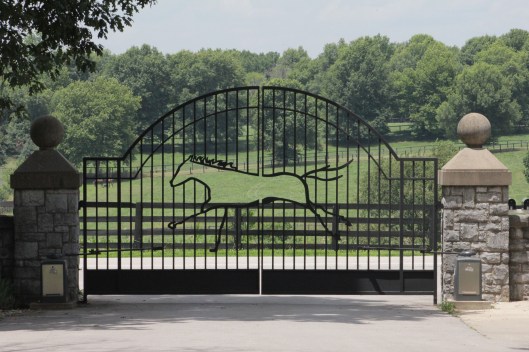
The gates to the fairgrounds hung open during a late morning arrival, with each half of the gate decorated with an ornate horse head design.

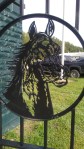
A glimpse into past history of the Cumberland County Fair, which also holds harness racing

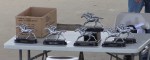
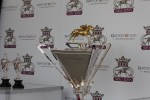
Trophies for the Thoroughbred races

Outside the racing office, saddle cloths with “Cumberland Co Fair” embroidered on them were neatly folded and stacked, waiting to be placed across the backs of the day’s runners. Immediately surrounding the racing office, horses stood patiently at the end of lead ropes attached to trailers and support posts for barns, while others were stabled at a barn nearest the gap that led onto the half-mile track.

It was a beautiful sunny day, perfect for racing. The track retained a fair amount of moisture on its surface from the previous day’s rains, but the track crew worked diligently to get the track closer to being rated good or even fast.

Ascending the steps on the perimeter of the grandstand and up a narrow wooden walkway to the announcer’s booth granted my first glimpse of the entire track from a more complete vantage point. Trees along the backside formed a barrier, along with a fence, from a nearby road and also created a beautiful backdrop in their lush greenery.

As may be guessed from a fair that has held racing since 1888, there were a lot of knowledgeable and dedicated horsemen on site. It was great to have a conversation between races about grooms and their importance, and horse care and management in general, with Bill Gross, the presiding judge, and to later veer into talking pedigrees—one of my particular obsessions about racehorses.

Fair racing was on my list of racing experiences to have for its unique aspect, and as the races began, it was evident it was going to provide opportunities to add to my racing knowledge, a welcome bonus.

Races restricted to Illinois-bred horses—5 of the 9 on the card, when the mule and pony races are included—were required by the Illinois Department of Agriculture to have at least three horses with three separate owners be entered and also break from the gate to meet the criteria to receive Illinois Department of Agriculture funding.

The first race of the day was a Quarter Horse race (the only one on the card specifically for that breed) at 220 yards, won by Bid of Shine in a time of 12 2/5 seconds. Line I One captured the following race, the first Thoroughbred race of the day, covering the four-furlong distance in a time of 59 2/5 seconds.

The third race was not restricted to Illinois-breds, and was able to run with only two entrants, Lucky Song Cat and Midnight Louis. It was a maiden race at 5 furlongs, and in the parlance of fair racing, “maiden” does not mean a horse who has never won a race as one is used to its definition being at pari-mutuel tracks. “Maiden” in this context means a horse who has never won on the fair circuit.

Lucky Song Cat, a gray horse, had been a $26,000 yearling purchase and had been victorious at pari-mutuel tracks. She had a lovely way of moving at a trot that was reminiscent of a dressage horse. Her stride at a run was long and reaching and everything about her revealed class and style, and she won the race, a fair maiden no more.

Schwarzkopf captured race 4 for his jockey Mike James, a regular rider at pari-mutuel tracks, and James rode that streak into the next race aboard Pirates On Line, giving him his fourth consecutive win for the day. Pirates On Line is also a winner of multiple races at the Cumberland County Fair, and his affinity for the track was on display as he crossed the wire in an easy-looking effort, with his ears pricked.

Before the card finale, the Cumberland County Derby at a mile-and-an-eighth, the mule and pony races were held. Fred the mule was the victor over his larger opponent, covering the short distance in front of the grandstand to the wire in a time of a little over 15 seconds.

The ponies, like the mules, also started from a standing position on the track with no starting gate, and several of them showed the distinction between pleasure horses and those conditioned to race when they attempted to run through the gap at the top of the stretch to go back to the barn. No discredit to their riders—just one of those things I’ve heard pleasure horses will attempt from time to time!

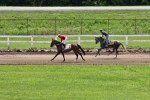
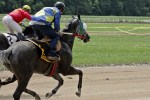
Line I One, the bay in front, warms up for his eventual victory
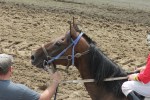
Lucky Song Cat

Lucky Song Cat nearing the wire
Lucky Song Cat after her victory

Schwarzkopf

Fred, the winner in the mule race

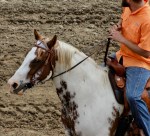
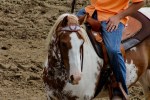
Interesting pinto pattern on this entrant in one of the pony races
The community feel of the racing was a wonderful element, as was the aspect of it drawing spectators for the love of the sport instead of also being driven by potential gambling payouts. It was a great time.

The final race of the day was split into two divisions with two runners each, with the ultimate winner being the horse who finished fastest in the two runnings. Division 1 featured Maelstrom and WW Spring Storm. Maelstrom won in a time of 1:59 4/5, setting the mark for Waz You Doing and Schiller in division 2 of the race.

Schiller, the 2017 winner, successfully defended his title in holding off Waz You Doing and covered the distance in a time of 1:59 2/5, giving him the overall victory against Maelstrom and WW Spring Storm as well, and his jockey Mike James a record six wins in one day at the fair.

With the racing over for another year on the closing day of the fair, the work began to convert the track into a setup for the evening’s Demolition Derby.

It had been a wonderful experience seeing fair racing for the first time, and I look forward to seeing more racing in similar venues in the future.

The interval between the Demolition Derby and the racing was filled with more racing talk, further highlighting how invested and sought-after horsemen from this region can be, as one gentleman shared fascinating stories of D. Wayne Lukas and working for him on the California circuit, and several people gathered were wearing Juddmonte hats, signifying professional ties to one of the most renowned farms in Kentucky.

The devotion to racing is certainly evident at every turn at the Cumberland County Fair, and it is incredible to think of it being conducted for well over a hundred years. It’s more low-key than the tracks that garner headlines on a regular basis, naturally, but no less worthwhile to attend for anyone who has racing in their blood. You’ll be among your kind and conversation about horses will flow naturally even with people you never knew before. What better way to spend a day if you love the sport?

Information about funding and conditions to be met for races to be run, as well as background details about horses entered, were provided by race announcer Kurt Becker’s commentary (drawn from his research) during the course of the race day.
A Visit With Justify

16 Thursday Aug 2018

Posted by Sarah Troxell in Uncategorized

≈ Leave a comment

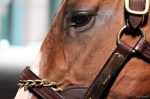
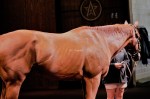
Justify, recently arrived at Winstar to begin his transition to retirement, was shown on a Horse Country tour there the morning of August 16, brought in from his paddock as rain swept across central Kentucky, streaking his chestnut coat.  Still learning to stand to be shown, he is behind a barrier of ornamental horse head posts linked by chains, and each tour attendee was given the opportunity to have photos taken with him.

Seeing him for the first time in retirement, it was still as astounding as ever to take in his muscular physique, seeming to be indicative of a horse much older than he is. After about 15 or 20 minutes, he was led back out to his paddock with a pat on the neck. He seems to be adjusting well (though the standing to be shown is still a work in progress), taking all in stride, just as he did on the Triple Crown trail.


The tour then went through the barn to see the other stallions in residence.

IMG_5555
IMG_5557

Pioneerof the Nile

Winstar office decor

20180816_123722
20180816_123728
20180816_123742
20180816_123838
20180816_123926
20180816_124010

Summer at Stonestreet

04 Saturday Aug 2018

Posted by Sarah Troxell in Uncategorized

≈ Leave a comment

Rachel Alexandra

Stonestreet’s grand lady was feeling feisty today, romping through her field and playing a bit with her buddies, pensioned mares in their 20s. In spite of Rachel’s dominance on the track, she is not the dominant mare in the pasture.


Rachel Alexandra and buddies

Weanlings

Rachel Alexandra lives on Stonestreet’s nursery farm year-round, and comes in for lunch when the weanlings do, as they all reside in the same barn. While the routine they follow mostly sees them living outside, coming in for lunch gives Stonestreet staff time to check over each weanling and take a temperature to keep a daily log. The foals have been weaned since my last visit in late July, and all have calmly settled into the routine, which has not varied much from when they were with their dams. They are still with the foals they grew up with, and each stop for a bite of grain outside the pasture gate before going in to their stalls, an incentive to come to the gate instead of be spread all across the pasture.

I got acquainted with Rachel’s Valentina’s colt a bit in the barn once he finished his lunch. As described, he does have quite a calm demeanor. He is buddies in the pasture with Fiftyshadesofhay’s weanling.

Curlin x Rachel’s Valentina colt
Rachel’s Valentina’s weanling

Curlin x Fiftyshadesofhay weanling


Rachel’s Valentina’s colt


Old Friends: The Horseman’s Tour

03 Friday Aug 2018

Posted by Sarah Troxell in Uncategorized

≈ Leave a comment

Retired jockey Joe Steiner led a new “Horseman’s Tour” at Old Friends one recent morning, telling insider stories and showcasing parts of the property not often seen on tours. Michael Blowen joined part of the tour, socializing with Silver Charm and attempting to get War Emblem to race him along the fence line.


Z Dager

It always feels like a privilege to see and have interactions with Silver Charm, who continues to perfectly embody all one could hope to see in a racing ambassador. His kind eye draws people in, and his nature appears nothing short of gentlemanly, as much as that seems to be a human characteristic.


War Emblem thrives at Old Friends, as well. He definitely has settled into a routine and his demeanor, while he will never be one that can have direct access to visitors, has mellowed somewhat. Steiner said he essentially decided when he was done racing when he went to the track one morning, theoretically to train, and refused to move one step that would have him joining the others that morning also getting in works. It was to eventually become the same story when he transitioned to a breeding career, famously refusing to breed mares at all, prompting his retirement from the breeding shed and opening the door to his repatriation to the United States. He seemed to want to do things his own way whenever possible, and may very well have found it reassuring that life at Old Friends doesn’t come with expectations to race or breed. He has dappled out nicely over the summer and is quite photogenic.


Afternoon Deelites stuck his head through a stall door nearby, beseeching the three visitors on the Horseman’s Tour for carrots.

IMG_5064

Afternoon Deelites

Alphabet Soup was also in a stall, with his relatively new constant companion, the donkey Gorgeous George. Blowen talked about the experimental treatments that were done for his melanomas, which responded by shrinking drastically.

IMG_5101

Gorgeous George

The tour then passed by several fields of horses off of the typical tour paths, including one that housed a horse who had sold for millions when younger.

A path to a part of Old Friends where I had never been before

Driving along a narrow path lined by trees that once had been a train bed, our group arrived at the home leased from Old Friends by Steiner and his wife, resident artist Dagmar and their young son. She recently completed a book of paintings honoring Old Friends residents, and had a lovely painting she created of Zenyatta hanging in the entranceway of their home. She paints in pastels, and studies the direction horses’ hair grows in to add another dimension of authenticity to her paintings. It was evident in the Zenyatta painting how meticulously she works, especially when examining the noseband on Zenyatta’s bridle, where each fiber appeared to have been painted individually and looked as realistic as a photograph.

Moving to the living room, her large painting of Silver Charm held court over the couch. It was nothing short of a masterpiece, capturing every nuance of Silver Charm, from the brown spots that dot his grey coat to the depths of his eyes and a nobility that transcended the single dimension and drew you in, much as his actual presence does. It was a painting that was difficult not to study for hours and to turn my back on (and it will be included in the forthcoming book), but to listen to Dagmar talk about a new style of painting she is trying, which primarily consists of geometric shapes and little detail, I did.

She also paints them upside down, and mentioned that it is an exercise in getting outside of her usual style, which is one of intense attention to detail. She also said that Picasso could paint in a straightforward style, where his subjects were easily recognizable, but that it can be beneficial to pick up a paintbrush and try a style outside of what might normally be used.

After the interesting visit with Dagmar, it was back through the property and along the train bed, with a stop at one of the fields that is not on the usual tours to feed carrots to the horses there.

Future plans were also discussed, like developing some recently acquired land and possibly opening up parts of the farm to guests in cabins. Blowen’s vision continues to grow, and while Steiner noted he can’t save all the horses, he’s to be commended for trying and for the impact he has made on their lives and how their stories touch the many people who visit each year and get to go home and say they’ve gotten acquainted with Game On Dude or fed a carrot to a Derby winner.

Stories of Catlaunch also abounded on the tour, with many of the Old Friends staff and volunteers stopping by to reminisce about the top Ohio-bred, since his owners were present on this Horseman’s Tour. The way a horse can touch a life, even with just a few moments of interaction, is a lot of what Old Friends is all about. Catlaunch touched many people during his time at Old Friends, with his incredibly sweet demeanor. His owner, touchingly, spoke of how he put his business name under owner instead of his own, because the glory belonged to Catlaunch.

This was an especially fitting tour for a story like that to be unfurled.

Off to the Races at Breyerfest

29 Sunday Jul 2018

Posted by Sarah Troxell in Uncategorized

≈ Leave a comment

Breyerfest, a celebration of model horses and their real-life counterparts, rolled into the Kentucky Horse Park in mid-July for its usual annual extravaganza. Each year, Breyer chooses a different theme that largely directs which guest horses are invited, what the special models are, along with a host of other details.

I was thrilled that this year’s theme was “Off to the Races.” Not only did that offer opportunities to see demonstrations by people and horses in the racing industry that I admire, but it also presented chances to learn about facets of racing beyond the Thoroughbred industry.

Several top Arabian racehorses were in attendance, like Empres and Spin Doctor. Based on information presented during their daily demonstration at Breyerfest and during a panel of Arabian racehorse owners and breeders, I learned that many Arabian racehorses go on to top show careers after racing. It was interesting to hear that the Arabian owners on the panel, with 40 to 50 years of involvement, had only bred in the range of 40 to 60 horses during that time, even with Arabian racing being somewhat limited in the U.S. One of the owners and breeders, a veterinarian, said they don’t start racing their horses until age 3 or 4, and will see tendon issues or other problems from time to time but no fatal breakdowns.

Both Spin Doctor and Empres are perfect examples of the versatility of the Arabian breed. Empres was foaled in Poland in 1995, racing there for one year in 1998. He has also lived in the Netherlands, the U.S. and Canada, where he now resides with his owner. In each country of residence, he has had a successful show career and stud career, producing foals that went on to success at shows and on the racetrack. Empres himself has won numerous championship titles in the show ring, in dressage, western, halter, and trail classes, just to name a few.

Spin Doctor successfully raced for three years, and was noted to appear to have the conformation and movement to excel in both racing and dressage in his first year of life. He proved that assessment by owner Cathy Smoke to be correct, as he makes strides in his post-racing life to transition to a dressage career, where he has already won a championship after a short time of training in that discipline. He is now 11 years old, and has been competing as a show horse for four years, with the aim of continuing to progress through the dressage levels.

Other notable attendees were Harley, the renowned track pony, Rosie Napravnik, Blythe Miller, Donna Barton-Brothers, Zenyatta’s first colt Cozmic One, and the top money winner in harness racing history, Standardbred Foiled Again, who had recently won his one hundredth race.

Retired jockeys Rosie Napravnik and Blythe Miller appeared in a panel of Women in Racing, moderated by Donna Barton-Brothers. (Napravnik also appeared in demonstrations with her off the track Thoroughbred, Old Ironsides, and with horses being retrained after their race careers for the Thoroughbred Makeover.)

During the Women in Racing panel, Napravnik spoke about her career from its beginning to her unexpected retirement. She would ride ponies in pony races as a child but unlike most of the kids who participated, she didn’t just pull them out of the pasture and race them; she actually trained them like racehorses and rode like a jockey even then, with her stirrups high. She knew she wanted to be a jockey very early on. It was her burning ambition, and that was reflected in the incredible amount of success she achieved in a very short time, success borne out of hard work and lots of preparation and an intense focus on her goals evident underneath the calm, even serene, demeanor she often presents when aboard a horse. That demeanor, observed when she rode on the track, was one I thought the horses probably picked up on and responded to well.

When she began riding as a jockey, she said trainer Dickie Smalls asked how she wanted to be listed in track programs. They settled on “A.R. Napravnik,” so that if and when she rose through the jockey standings, trainers would see who was among the top jockeys at a track and want that jockey, not having any possibility of bias creeping in because of her gender before she became known.

She never let notions about what women could or couldn’t do hold her back during her career, and when she spoke of resistance she faced, it was not with malice or bitterness. Instead, encountering resistance further fueled her determination to excel.

At one point, she heard a comment about how women working at the track would rather be getting their nails done, and that drove her to never wear makeup at the track so that no one would question what she was there for.

She also said when she encountered trainers who told her they wouldn’t hire female jockeys, she eventually did ride for every one of those trainers and win for them, noting that they couldn’t ignore success.

Later, Napravnik rode in a preview of the Thoroughbred Makeover that will take place this fall at the Horse Park, a preview that Cozmic One also participated in. I spoke to his young rider in charge of his progression for the Makeover. She said he hated racing but has taken well to show jumping. I followed him only sporadically, and standing next to him was a bit of a revelation, as I had either not realized or had forgotten he had inherited Zenyatta’s height, standing at 17 hands or a shade taller. He was a little antsy in his stall but once outside of it revealed a calm demeanor and seemed to take everything in stride. He is a nice mover, reminding me of how a lot of foundation work was put into him to get him to even be able to be tractable to be trained for racing. He is in good hands to go on to the next phase of his working life.

It was incredible to see how far the other Thoroughbreds in the Makeover had come already, with just a short time off of the track. They had never been in a rather open setting like the outdoor ring where the presentation occurred, yet they handled it well. One even was ridden around bridleless, though initially his rider was not sure how he would react to that. But after a brief warmup she saw it didn’t faze him and rode him in front of the gathered audience without his bridle.

Seventeen-year-old Brass Hat, Breyerfest’s Celebration Horse this year, was another nice mover as he appeared in the arena each day before attendees, and he appeared to love the attention from people who congregated at his stall to get acquainted.

It was an incredible three days of a celebration of racing and horses that have touched people’s lives because of it.

Cozmic One
Rachel Alexandra custom model horse

Harley
Rosie Napravnik rides in a demonstration for the Thoroughbred Makeover

Retired top Arabian racehorse Spin Doctor
Spin Doctor
Brass Hat

Display honoring Brass Hat and connections outside his stall
Brass Hat

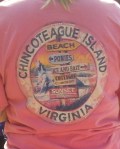
I hope to visit Chincoteague someday during Pony Penning, so I loved seeing this shirt one attendee wore while waiting in a line (and nice to be among people who also are drawn to other horse events such as that one)
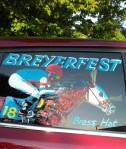
An attendee’s car decorated to fit the year’s Breyerfest theme and also honor celebration horse Brass Hat
Foiled Again

Sources:

http://www.empres.ca

http://www.empres.ca/showcareer.htm

“2015 SHN Rally in Raleigh.” Molly A. Benstein. Modern Arabian Horse: Issue 6, 2015.

Fasig Tipton July sale

20 Friday Jul 2018

Posted by Sarah Troxell in Uncategorized

≈ Leave a comment


Half sibling to Mine That Bird and Dullahan, entered in the Horses of Racing Age portion of the sale
Palace Malice yearling
American Pharoah filly, his only yearling in the sale

American Pharoah filly


American Pharoah filly out of Yong Musician

Belle Meade: A Grand Thoroughbred Legacy

06 Friday Jul 2018

Posted by Sarah Troxell in Uncategorized

≈ Leave a comment

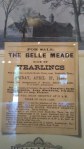
Belle Meade was founded in 1807, and had Thoroughbreds standing at stud within 10 years of that date, launching an equine dynasty closely linked with the family who resided there and saw it become one of the premiere Thoroughbred farms in the country. As Jenny Lamb wrote in a history of the farm, “it was customary for Southern gentlemen to own and race Thoroughbreds at that time,” and when farm founder John Harding moved from Virginia to Tennessee, he brought that tradition with him.

It’s been decades since Tennessee was a fount of top racehorses, though there is still a limited breeding industry there today. That makes it even more interesting that the bloodlines of horses raised and bred at Belle Meade have progeny in top races around the country to this day.
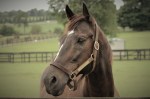
Nashville had its own racetrack then, and several others in close proximity. John Harding’s son William followed in his father’s footsteps, helping him train horses and bringing more prominence to the breeding industry in Tennessee by launching yearling sales in 1867 of horses he bred, held nearly continuously until 1902.

One plaque on the property featured a quote from William Giles Harding, written to the American Turf Register in 1839, the year he took over Belle Meade from his father John, further attesting to Tennessee’s importance in the Thoroughbred world at that time. Harding wrote, “This, I suppose is the acknowledged center of the horse racing region. Blood stock here is all the go. To be without it is to be out of fashion and destitute of taste. So, I too, have procured a little of the real grit which by-and-by I hope to increase.”

It is interesting to note what he said, given that it could now be used to describe Kentucky and is a mere afterthought of Tennessee’s contributions to racing, if thought of at all.

The farm achieved even greater prominence when Selene Harding, William Harding’s daughter, married General William Hicks Jackson, who moved to the Belle Meade property and was granted 1/3 of the ownership of the farm. He acted as “daily manager… and his flair for entertaining and his confident outgoing nature helped the farm to attract thousands of people to the yearling sales,” according to Jenny Lamb’s record. Dignitaries flocked to the renowned farm, drawn by its name and the Jackson family’s status in society. Thoroughbreds had indeed made the difference John Harding anticipated they would when he founded Belle Meade and sought to emulate the gentlemen of his day.
The family did have an enslaved populace during most of the years they owned Belle Meade, and one footnote to that provided insight I had never heard before about what happened to men who served in the Confederate Army after the Civil War was over.  The tour guide during my visit made certain to mention it would not be sugarcoated that this too, was part of the farm’s history.  William Giles Harding was imprisoned in Michigan for 6 months for his role as a staunch supporter of the Confederate cause and his service, after which he was returned to Belle Meade and placed under house arrest for the rest of his life, according to the tour guide.

Family illnesses, deaths, and financial concerns began to signal the end of Belle Meade’s status in the early 1900s, although William Harding Jackson inherited the estate at the age of two, along with his aunt and a few other family members. Jackson went on to serve as Deputy Director of the CIA, the first in his family in generations not to have a strong link to Belle Meade and the tradition that had been fostered. He found his success elsewhere, understandably since the plantation lifestyle and the Thoroughbred’s importance in Tennessee were both receding quickly.

Another interesting item of note from the tour guide was that the reason the Thoroughbred industry died out in Tennessee was partially because of the temperance movement and their strong condemnation of any social public gatherings that involved drinking and gambling, and they did target the racing industry. Kentucky was described as having been a few steps ahead of the temperance movement, so the racing and breeding industry retained its foothold there.

Yet without the commitment to the breed and industry shown by generations at Belle Meade, some of the foundation that flows through the bloodlines of the Kentucky industry would not be present.

Bonnie Scotland was far and away Belle Meade’s most successful sire. He was imported from England to the U.S. in 1857, standing stud in several states before being acquired by Belle Meade when they lost their top stallion, beginning his stud duties there in 1873.  He was America’s leading sire in 1880 and in 1882, though he died early in 1880. He is the grandsire of Ben Brush and many twentieth century Kentucky Derby winners trace their lineage to Bonnie Scotland, among them Secretariat, Seattle Slew, and Affirmed.

Iroquois was another renowned import acquired by Belle Meade, and was the first American-bred to win the English Derby, and also won the St. Leger.  He was acquired by Belle Meade after his racing career, and his 1892 stud fee of $2,500 was a huge sum at the time and he also became a leading sire. In fact, Iroquois was so revered at the farm that there are to this day two unique items associated with him in the grand Belle Meade mansion.

One is an elaborate creation of his pedigree, entirely hand-stitched and hanging on the wall in a frame. I have never seen any other pedigree created like it. Iroquois’ photo was at the center of it and radiating outwards were the names of his ancestors enclosed in circles and with most having their notable racing achievements listed beneath their names.

The other “memorabilia” in the home associated with the famed horse were a pair of his hooves, preserved after he died of kidney-related ailments, sitting on a desk.

Luke Blackburn, while not owned by Belle Meade, was a prime example of the excellence his sire Bonnie Scotland was renowned for producing. He won 15 consecutive races as a 3-year-old in 1880, and upon retirement he took up stud duties at Belle Meade. He had only three stakes winners, but he wrote his name in racing history with his prowess on the track and was inducted into the Racing Hall of Fame in 1956.

Enquirer was sired by Leamington, and descended from Diomed. He won 7 of his 9 starts, and was named champion three-year-old of 1870 after winning all of his races that season. He quickly became a success as a sire in Kentucky, and was acquired by Belle Meade in 1879 for stud duty. Author Ridley Wells II wrote in Belle Meade Bloodlines that the plan behind his addition to the stud roster there was to succeed Leamington as the top American sire and “back up the aging Bonnie Scotland…however, Enquirer did not succeed Leamington as the top American sire; Bonnie Scotland did.”

Enquirer did continue his streak of success, however, and was among the top sires annually, ranking third on that list in 1886, and remained at Belle Meade until his death in September 1895.

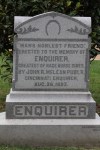
Since Enquirer was named for the newspaper the Cincinnati Enquirer, Wells wrote, “During the Tennessee Centennial Celebration [in 1897], a handsome marble monument was erected to Enquirer’s memory at Belle Meade by John R. McLean, publisher of the Cincinnati Enquirer. About 400 people, including a large group from Cincinnati, were present for the dedication exercises held over the horse’s grave in his paddock. The monument now stands near the stable at Belle Meade.”

Wells also wrote of Gamma, a gray filly foaled in 1836 who went on to win several 4-mile heats in the course of her race career. She was also not a product of the Belle Meade breeding program, but was purchased as a three-year-old by General Harding and endeared herself to him by defeating the great Wagner in a four-mile race when she was four years old. “She was considered ‘one of the gamest and most beautiful race animals that ever graced the turf of Tennessee.’ After her turf career ended, she served many years as a broodmare at Belle Meade, bearing several colts that won renown. Gamma died at Belle Meade on February 24, 1867, in her thirty-first year. General Harding’s eyes teared when he showed her portrait to visitors.”

Those are just a sampling of the top horses that were bred or served as sires or broodmares at Belle Meade. In addition to being honored with portraits still hanging in the home, like the one referenced of Gamma, some of the successful horses are also remembered with wines named after them that are offered at Belle Meade. Each tour includes a wine tasting with a chance to purchase bottles of wine named after Enquirer and Iroquois.

One final note about the Belle Meade legacy comes from The Thoroughbred Record in 1923:

“When they had racing at Memphis and Nashville, Tennessee was full of breeding farms and some of the foremost citizens of the state were engaged in breeding thoroughbred horses. A very few breeders still continue to breed good horses in that state because they can’t help it–it is a natural attribute, but the great thoroughbred horse breeding industry of Tennessee is gone, in eliminating horse racing they established and uncongenial atmosphere and drove most of the breeders out of business. And what a superlative record Tennessee has as a breeding state, farms such as Belle Meade and Fairview, would each have fifty or more yearlings to sell at public auction annually, while Captain James Franklin, with only a small number of mares, sent to the races such equine stars as George Kinney, Luke Blackburn and many other high class horses. Belle Meade is one of the oldest of the Western thoroughbred nurseries. It was settled by Mr. John Harding, the father of General W.G. Harding, in 1804. The mighty Priam, winner of the English Derby in 1840, here held court, also Eagle and Bluster, imported horses, were in their day at the head of Belle Meade Stud. Here too the mighty Vandal, great Jack Malone, Sir Richard, Highlander, and Childe Harold, each succeeded in his turn to become lord of the manor. These were succeeded by imported Bonnie Scotland, who died full of years and honors in 1880. John Morgan, Enquirer, imp. Great Tom, Luke Blackburn, Bramble and Iroquois followed as reigning monarchs on the throne of Priam and Vandal. The number of great race horses bred at Belle Meade is legion, among the number is Gamma, the mighty grey mare which dominated the turf in her day, about seventy-five years ago. Charles Reed’s Fairview Farm was another famous nursery that sent annually to the races horses of great distinction, among the number may be mentioned Don Alonzo, Hornpipe, Woodcutter…and many others that were champions in their day. All this emphasizes the fact that Tennessee is one of the best horse breeding states in the Union, but on account of adverse legislation and no racing, the business has fallen from the proud position it once held as an important agricultural asset to the state. Maryland is reviving and emulating the deeds of her early pioneers in establishing pleasant, comfortable homes out on the farms and breeding high class horses. It would be possible with a reasonable law to attain the same results in Tennessee.”

Nearly one hundred years since those words were written, racing has not regained its foothold in Tennessee and is unlikely to, yet the legacy of Belle Meade endures. It became even greater than it was ever hoped for, when owning Thoroughbreds enhanced the status of the individual. Instead those Thoroughbreds and their descendants went on to enhance the status of the breed itself, with careful management and wise investments in horses with top pedigrees and excellent race records. Their names are remembered and written in racing annals, and some are inscribed in the Hall of Fame. Yes, Belle Meade has endured.


Sources:

Belle Meade Bloodlines, Ridley Wells II, 1990.

The Thoroughbred Record, April 14, 1923.

“Luke Blackburn.” https://www.racingmuseum.org/hall-of-fame/luke-blackburn

“Bonnie Scotland.” http://www.tbheritage.com/Portraits/BonnieScotland.html

The Ladies (and foals) of Stonestreet

06 Friday Jul 2018

Posted by Sarah Troxell in Uncategorized

≈ Leave a comment

June 2018

IMG_4288

Rachel Alexandra

It is always a thrill to see my favorite race mare. This was my first time seeing her in about a year, and it was even better that she came over to greet her guests and I got to pat her on her incredibly soft nose, contact she doesn’t always seek.

Stonestreet is always incredibly gracious, and even thought of providing ideal photo opportunities of their star, briefly removing her fly mask for this visit.


Part of the broodmare band

Rachel’s Valentina, part of the illustrious broodmare band, had an impressive-looking Curlin colt this year, her first foal, and has been bred to Pioneerof the Nile for a 2019 foal. Many of the foals below were also by Curlin, and some of the dams include Fiftyshadesofhay, My Miss Aurelia, and Maggy’s Melody, a daughter of Afleet Alex’s dam Maggy Hawk.


Rachel’s Valentina and her Curlin colt


IMG_4147
IMG_4266

Some of the beautiful layout of the farm, formerly Buckram Oak, and now managed by Barbara Banke in a serene setting for the nursery portion of the farm, where the mares live with their foals until weaning, when they are moved to a different Stonestreet property until they foal again. Barbara Banke has expanded the Stonestreet operation into Australia, continuing to build upon the legacy her husband began, with nothing less than a goal of world domination.

Feting the Newest Triple Crown Winner

23 Saturday Jun 2018

Posted by Sarah Troxell in Uncategorized

≈ Leave a comment

Downs After Dark, June 16


Racing entities’ autographs on the Breeders’ Cup statue

One of the entrants for the 2018 Breeders’ Cup program, on display to be voted on to be the program cover
Another contender for the 2018 Breeders’ Cup program

Breeders’ Cup statue

Parading Justify


One of the wonderful things about sporting events and gathering at them in person is the camaraderie that can be created. It can be all too easy to find divisiveness in differences of opinion and clashes when individuals from various social media “bubbles” cross one another’s paths.

That is why Justify being paraded at Churchill on June 16, a week after his Triple Crown victory, was a credit to the sport on many levels.

Arriving at Churchill earlier than expected, I had time to talk to several ladies who had never seen him in person and trade stories of racing memories, and later read news accounts of one woman who drove seven hours to see Justify that day and made friends with the people on either side of her.

While Churchill offered its usual plethora of stakes races that Stephen Foster day, Justify was naturally the biggest draw, and throngs of people held spots at the paddock even in the sweltering heat well ahead of his appearance.

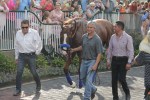
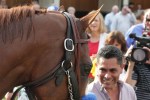
One of my favorite moments was when his connections stopped him at the request of the crowd, to give everyone a chance to take his photo while he stood still and took everything in stride, just as he appears to always do. It was also wonderful to see the pride evident in the dazzling smile of Humberto Gomez, Justify’s exercise rider, as he accompanied the colt around the Churchill paddock along with assistant trainer Jimmy Barnes and groom Eduardo Luna.

Wherever Justify goes from here in his racing career, time will tell. With a crown newly placed by his name over the Churchill paddock in the spot reserved for the most recent Kentucky Derby winner and the crowds gathering just to see him walk the paddock, it also reminds me “time loves a hero,” from the title of a favorite Little Feat song, and a Triple Crown winner is certainly hailed as a bit of a conquering hero in racing circles.

Nothing will shake how glorious it was to witness him as he stood like a statue when his connections were requested to have him stop for photos, or how wonderful it was to know he crossed that wire first in the Belmont.

Even his gallops around Churchill post-Belmont further revealed what an extraordinary athlete he is, still looking well and full of energy.

It will be most intriguing to see what he does achieve from now on, even more so for half of his total races comprising the Triple Crown.
 

Justify’s Triple Crown trophy
Justify’s Derby trophy


Gallery

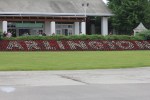
Arlington Park: A Jewel of a Track

23 Saturday Jun 2018

Posted by Sarah Troxell in Uncategorized

≈ Leave a comment

This gallery contains 26 photos.

June 2018 My first visit to Arlington Park was like a photographer’s dream, incredibly aesthetically pleasing as soon as I …

Continue reading →

← Older posts
Newer posts →

Recent Posts

  • Serena’s Song: A Singular Life
  • Afleet Alex: An Enduring Presence
  • D. Wayne Lukas
  • Small Miracles
  • The Meaning of Caldera

Archives

  • March 2026
  • February 2026
  • June 2025
  • March 2025
  • February 2025
  • November 2024
  • May 2024
  • April 2024
  • February 2024
  • October 2023
  • August 2023
  • April 2023
  • July 2022
  • June 2022
  • May 2022
  • April 2022
  • March 2022
  • January 2022
  • December 2021
  • November 2021
  • October 2021
  • September 2021
  • August 2021
  • July 2021
  • June 2021
  • May 2021
  • April 2021
  • February 2021
  • November 2020
  • October 2020
  • September 2020
  • August 2020
  • May 2020
  • April 2020
  • January 2020
  • August 2019
  • March 2019
  • February 2019
  • January 2019
  • October 2018
  • August 2018
  • July 2018
  • June 2018
  • May 2018
  • March 2018
  • February 2018
  • January 2018
  • December 2017
  • November 2017
  • June 2017
  • May 2017
  • April 2017
  • March 2017
  • February 2017
  • October 2016
  • August 2016
  • March 2016
  • November 2015
  • October 2015
  • September 2015
  • August 2015
  • June 2015
  • May 2015
  • April 2015
  • March 2015
  • January 2015
  • December 2014
  • October 2014
  • August 2014
  • April 2014
  • March 2014
  • February 2014
  • January 2014
  • December 2013
  • October 2013
  • June 2013
  • May 2013
  • April 2013
  • February 2013
  • January 2013
  • December 2012

Categories

  • Uncategorized

Meta

  • Create account
  • Log in
  • Entries feed
  • Comments feed
  • WordPress.com

Blog at WordPress.com.

  • Subscribe Subscribed
    • Called To The Post
    • Already have a WordPress.com account? Log in now.
    • Called To The Post
    • Subscribe Subscribed
    • Sign up
    • Log in
    • Report this content
    • View site in Reader
    • Manage subscriptions
    • Collapse this bar
 

Loading Comments...